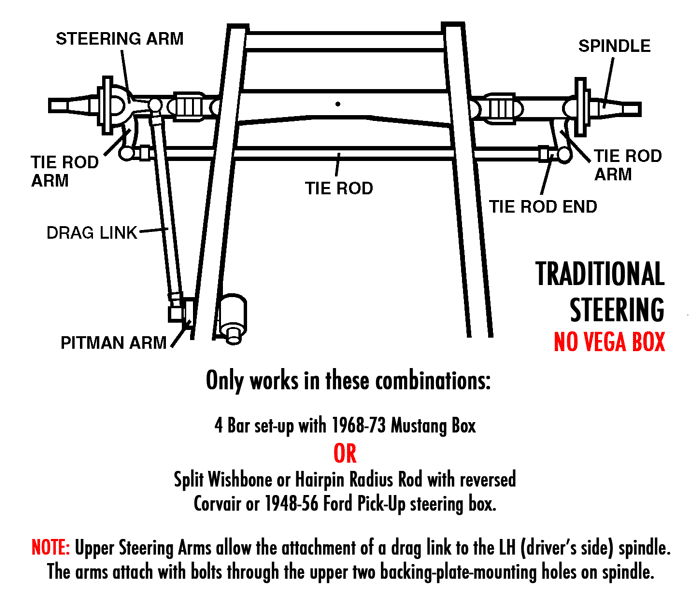
This is a very old way of doing things (read pre mid-‘30s or early '40s). You would probably end up with the drag link wanting to flex it is too long and create some geometry problems (OK for certain types of race cars but on the street it is not that desirable for good road handling manners. Racing moved away from beam axles many, many years ago because of some of the limitations of a solid axle). You also have to deal with the Pittman arm arc plus the arc of the spindles working at the same time; it works but it primitive. The drag link and spindles must remain level at both ends of the Pittman arm swing.
Cross link steering (common with Vega (the diagram you have from Speedway is very old. Vega steering was used but it is not designed for the weight and loads racing may put on it)/Ford truck or first gen Falcon and Mustang steering box conversions [some of them are mounted on their sides for the style you pictured] to early Fords w/beam axles) will also have multiple cross-link and spindle arcs to deal with.
With either of these methods you will want to add a Panard Bar of some sort to keep the axle centered under the car because of the movement encountered by the required spring shackles to the beam. You will also need to have either split wishbone, radius rods or hair pin rods to support the axle keeping it perpendicular to the chassis.
You see this type of conversion done with rat-rod VWs and you get the under-bite/extended/suicide look of suspension where the spring perch is mounted ahead of the frame. I know that there are several companies that make a VW to I-beam conversion and should be easy to find if you look around: for example:
http://www.speedwaymotors.com/SoCaLook- ... ,4040.html. Actually there are several names for it depending on how the tire rods are mounted; e.g., behind the spindles, in front of the spindles but down low or in front of the spindles but mounted above them (I seen to remember that the versions mounted in the rear are called Suicide or Bull-dog. I always thought the link between the two spindles when mounted to the front were too subject to accidental [or on purpose] damage being out front). I guess the look is OK as long as that is the look you want.
Beam axles do have some handling benefits; e.g., the transferring the up and down loads from one wheel to the other, but a lot of that can be accomplished in the IFS by using sway-bars; they transfer some of the up-and-down loading from one side’s suspension to the other side as long as there is some kind of support in-between. VW uses sway bars that do not connect in the middle because the torsion tube accomplishes some of the same functions that connecting the sway bar to the middle via pivot supports. Even in the late ‘40’s and early ‘50s they were adding sway bars to the beam cars.
You will also have to figure out some methods of shock mounting and locations as beam axles use several different methods going from lever style shocks (movable linkage required) to tube shocks.
Since I saw racing in your signature: If you want to go solid axle there are many different methods that do not use a transverse spring although I do not think parallel leaf-springs are any better, maybe worse.
There are also several companies that offer IFS conversions to BJ beam cars that are either bolt in or almost bolt in; I think Mendeola (
http://www.mendeolasuspension.com/) may be one of them but there are several others that are easy to find on a search. I was going to post a URL for one other but it seems to have taken a dump and it has been replaced by a real estate site.
Lee
Clarified and added some additional information.