I am new to the Volkswagen world and just bought a '65 Bug about a month ago. I am currently taking an engine rebuilding class at school and have been using the engine as my class project. I've been doing research and from what I have read I have a 1200cc motor. I also believe that this is an all numbers matching car (bought it froma little old lady). What I am having problems with is knowing whether or not my suspicions about it being numbers matching are correct. From what I can tell (VIN tag has paint on it) the body and pan match and they start with 115 (off the top of my head). I have a D block starting with 950. I haven't checked the transmission yet. Am I doing this right or am I going about it all wrong?
Tl:Dr How do I know if my 65 Bug is numbers matching?
I can post pictures if need be.
Need help identifying engine.
-
Slow 1200
- Posts: 556
- Joined: Mon Jun 17, 2002 12:01 am
-
Marc
- Moderator
- Posts: 23741
- Joined: Thu May 23, 2002 12:01 am
Re: Need help identifying engine.
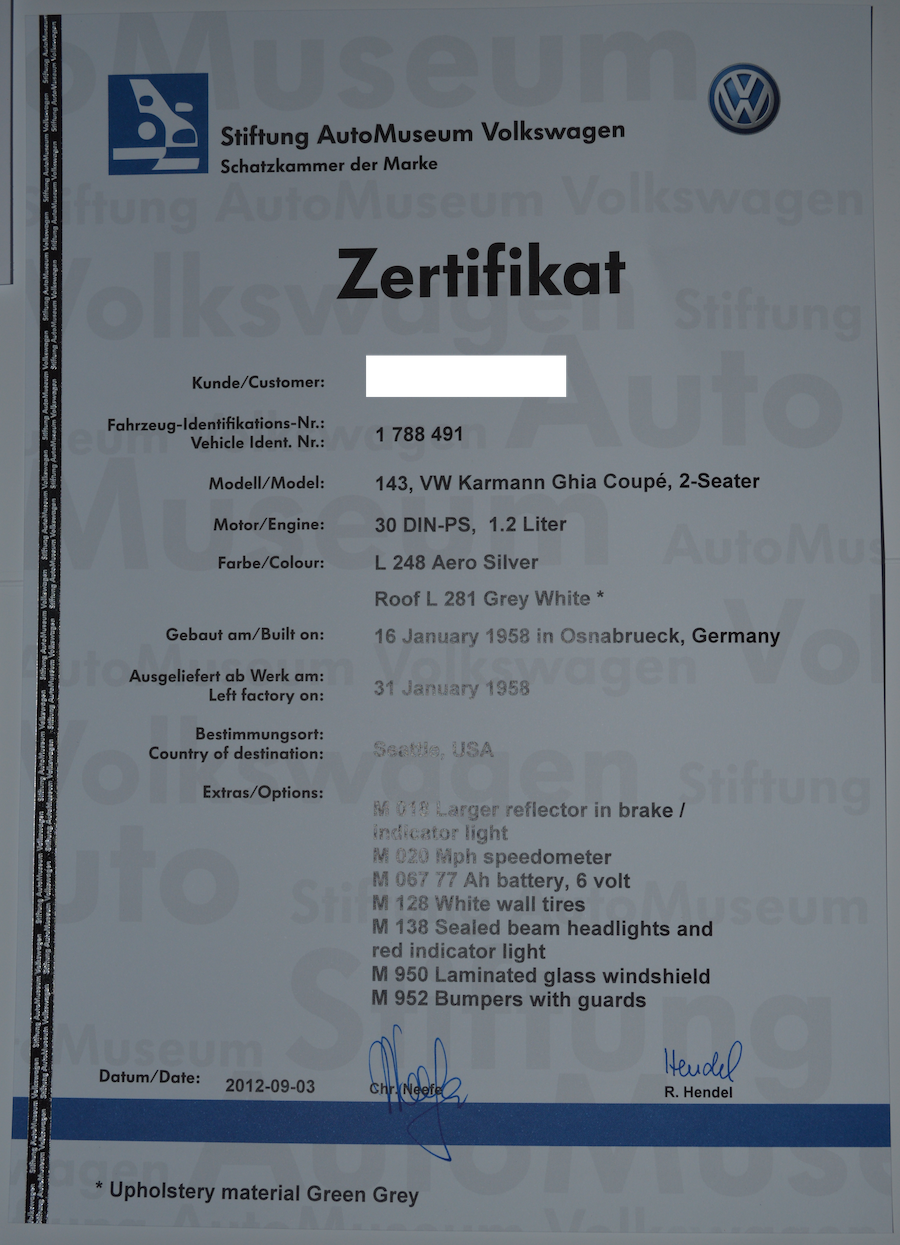
I don't know of any way to confirm that the engine and transaxle are the exact ones it had when it left the factory. Even if you spent the money for a "birth certificate" for the car, those numbers would not be on it (example below). The good news is that as long as the numbers are appropriate for the production date of your car, nobody's going to be able to tell if it isn't "numbers matching" either.
I believe, however, that the engine has been replaced. I don't think that the convention of using the "D" prefix to denote 1200cc predates the 1966 model year, when the "F" (1300cc) engine was offered as an option (all US-market `66s got the bigger engine). `66 1200 engine numbers ran from D0 000001 through D0 095049, so it looks like yours may have been replaced with one made in late `66. Is there a "factory exchange" mark near the number? It's a little VW logo encircled by two arrows.
Other than the numbering scheme, there's no difference between a "9-million" `65 engine and a "D" 1200 - both have insert cam bearings (unlike older engines) and the best 1200 heads ever made, with 1.1:1 rockerarms (earlier 1200s had 1.0:1). 9-million/"D" have slightly longer head studs and pushrods than the older 40HP engines, and the top of the case looks different at the parting line next to the oil cooler (the casting is wider at the parting line there than at the adjacent areas - on non-cam-bearing cases it's the same width all along the top seam).
Midway through 1966 model year production VW changed the way that the flywheel was sealed to the end of the crankshaft from a gasket to an O-ring. The crank "nose" was machined further, and a groove machined into the 'wheel to give the O-ring a place to live. If your engine is late`66 as I suspect, its flywheel and crank will be different than most. A 109-tooth ("6-volt) flywheel with 180mm clutch and O-ring is specific in the US market to a late`66 1300, yours would be like that. The 64mm stroke 1200 crankshaft with a snout machined for O-ring was never used on any original engine for the US market. "Normal" (gasket-style) components may be used as replacements if needed but there are some caveats and some machinework may be needed. The endplay shims of the O-ring setup have a 1mm smaller I.D. and you must never use the earlier, larger-I.D. shims - they tend to sling about and will actually slice through the end of the crankshaft.
http://www.basilari.com/wp-content/uplo ... -small.png
I believe, however, that the engine has been replaced. I don't think that the convention of using the "D" prefix to denote 1200cc predates the 1966 model year, when the "F" (1300cc) engine was offered as an option (all US-market `66s got the bigger engine). `66 1200 engine numbers ran from D0 000001 through D0 095049, so it looks like yours may have been replaced with one made in late `66. Is there a "factory exchange" mark near the number? It's a little VW logo encircled by two arrows.
Other than the numbering scheme, there's no difference between a "9-million" `65 engine and a "D" 1200 - both have insert cam bearings (unlike older engines) and the best 1200 heads ever made, with 1.1:1 rockerarms (earlier 1200s had 1.0:1). 9-million/"D" have slightly longer head studs and pushrods than the older 40HP engines, and the top of the case looks different at the parting line next to the oil cooler (the casting is wider at the parting line there than at the adjacent areas - on non-cam-bearing cases it's the same width all along the top seam).
Midway through 1966 model year production VW changed the way that the flywheel was sealed to the end of the crankshaft from a gasket to an O-ring. The crank "nose" was machined further, and a groove machined into the 'wheel to give the O-ring a place to live. If your engine is late`66 as I suspect, its flywheel and crank will be different than most. A 109-tooth ("6-volt) flywheel with 180mm clutch and O-ring is specific in the US market to a late`66 1300, yours would be like that. The 64mm stroke 1200 crankshaft with a snout machined for O-ring was never used on any original engine for the US market. "Normal" (gasket-style) components may be used as replacements if needed but there are some caveats and some machinework may be needed. The endplay shims of the O-ring setup have a 1mm smaller I.D. and you must never use the earlier, larger-I.D. shims - they tend to sling about and will actually slice through the end of the crankshaft.
http://www.basilari.com/wp-content/uplo ... -small.png
-
Ol'fogasaurus
- Posts: 17881
- Joined: Mon Nov 13, 2006 10:17 pm
Re: Need help identifying engine.
That is what confused me too, I looked up the pan numbers and they seem to be correct but the engine number should start with a 3 or 4 based on the book I have. I the book I have: "U" is associated with type III engines; e.g., U (space) 0 000 001 in '68 and ending at U (space) 0 502 000 in '71. Starting at U (space) 5 000 001 and ending at U (space) 5 057000 in 72 (source the EMPI catalog for 2010).Marc wrote:I don't know of any way to confirm that the engine and transaxle are the exact ones it had when it left the factory. Even if you spent the money for a "birth certificate" for the car, those numbers would not be on it (example below). The good news is that as long as the numbers are appropriate for the production date of your car, nobody's going to be able to tell if it isn't "numbers matching" either.
I believe, however, that the engine has been replaced. I've never seen an original 1965 engine with the "D" prefix
http://www.basilari.com/wp-content/uplo ... -small.png
Marc just did a short treatise on type III engines and the original question was a bit different but there might be some usable information here:
“... On Type I cases you can (usually) identify a case pretty well just by the prefix letter. Not so much on a III, you need the entire serial number to nail down the production date.
U means D-Jetronic 1600cc with a ~7.64:1 CR. The numbers started in `67 (for the `68 model year) with U0xxxxxx and ran through into the `73 production. There were other sequences, such as U5xxxxxx for the ~7.3:1 version or T0xxxxxx for dual-carbs (not offered in the US past the `67 model) as well.
Regardless of the ID letter/number, Type III cases were comparable to contemporary Type I cases when it came to oil passages & metallurgy. They lacked a dipstick tube or threaded hole for the oil pressure sender, and those fitted to cars with IRS rear suspension (starting with the `69 model year) all had special castings with bosses to allow the drilled/tapped holes for the rear engine hanger "moustache bar". `68-`71 IRS Bus cases also had these holes, and sometimes those case castings were diverted to Type I production but only the Thing used them (not for a hanger, but for a skid plate).
`68/`69 cases (H5 Beetle, B5 Bus, U0 III) were all single-relief, small-passage cases cast from the worst alloy ever used in any VW case, referred to as "cottage-cheese" because they crack/crumble/warp and suffer pulled threads worse than any other. These are junk, suitable for keeping the rain off of any potentially usable internal parts.
`70 (B6 or U0) had the larger passages and dual-relief temp/pressure control setup, and a better alloy. OK for a stocker, maybe.
`71 Bus & `71-`73 10mm head stud Beetle "AE" and `71 III U0 came in two versions. The early ones had a smooth panel above the dipstick, the later ones have horizontal washboard ribs cast in. In my experience the "un-ribbed" ones are little (if at all) better than the `70, while the "ribbed" are cast from a substantially better alloy. Another important characteristic is the "sunken-stud" modification where the top-front head stud for #3 cylinder is longer than the other 7 top studs, and screwed deeper into the case in order to stagger the stresses below the cylinder, a spot where earlier cases were infamous for cracking. This mod can be done to a `70 case, after which it's the same as an early `71. No 10mm head-stud case had "case-savers" (threaded steel inserts where the studs screw into the case) with the exception of some factory-exchange engines, but they can be fitted...a very good idea, their larger diameter makes them less likely to pull than plain studs.
Type IIIs with automatic transmissions used cases made with a unique casting that provides wrench clearance to get to the torque converter bolts. One can grind enough from a 4-speed case to just manage the job, but a real auto case is a rare item...ID code is no different than the contemporary 4-speed case.
Cases with 8mm head studs were introduced for both Beetle and Type III for the `73 model year, although 10mm cases were still produced. The 8mm studs are preferable for most applications (conventionally aspirated ones, anyway) because although the don't have the same ultimate strength they do expand and contract with heat-cycling at a rate closer to that of the rest of the top end. This helps regulate the clamping pressure and they tend to have fewer incidences of head-to-cylinder leakage. This is a worthwhile modification to make to an earlier case.
Obviously if you're going to use a Type III case in a Beetle you'll need to have it drilled and a dipstick fitted, or you can use a funky aftermarket tube with a flange that bolts up where the Type III filler tube goes. You'll also want to drill/tap it for the oil pressure sender. To install a Type I "doghouse" cooler the long m6x1.0 cooler stud should be replaced with a shorter m8 x 1.25, and the two 6mm "ear" holes drilled out to 8mm.
None of this info is relevant to flat6, though - I only furnished it for the benefit of someone searching the subject in the future.
For a 300HP engine, NO stock case, no matter how nice or new, is adequate IMO. You need a new aluminum case...there are several choices out there, just bring money.”
-
SpindlyMan
- Posts: 4
- Joined: Tue Oct 01, 2013 6:47 pm
Re: Need help identifying engine.
Thanks for the info Marc! 
I have attached a photo of my engine number. Circled in red looks to be a VW logo and right next to it in yellow is the D letter. That leads me to believe it's a D block or I may be wrong. It is a 1200cc tho, correct?
What could a factory swap mean? Was the car shipped back to Germany to have it replaced or was the engine shipped over and replaced here in the states? The little old lady said the engine was rebuilt and I do have a used crankshaft, camshaft, four jugs and four pistons that came with the car. There's also a spare crankcase in the back seat. I can get those numbers tonight, I do believe it has a D in the same location as the attached photo. So either one of the cases belongs to it or neither of them do. Haha!!
I know I am asking so difficult questions and if they can't be answered it ok.
I have attached a photo of my engine number. Circled in red looks to be a VW logo and right next to it in yellow is the D letter. That leads me to believe it's a D block or I may be wrong. It is a 1200cc tho, correct?
What could a factory swap mean? Was the car shipped back to Germany to have it replaced or was the engine shipped over and replaced here in the states? The little old lady said the engine was rebuilt and I do have a used crankshaft, camshaft, four jugs and four pistons that came with the car. There's also a spare crankcase in the back seat. I can get those numbers tonight, I do believe it has a D in the same location as the attached photo. So either one of the cases belongs to it or neither of them do. Haha!!
I know I am asking so difficult questions and if they can't be answered it ok.
You do not have the required permissions to view the files attached to this post.
-
Bonemaro

- Posts: 414
- Joined: Mon Sep 14, 2009 11:45 am
Re: Need help identifying engine.
Interesting this came up. Just this morning I was looking at the engine in my 73 Ghia and I believe it's from a 72 Bug... unless I'm not reading it right.

Jim
My 1973 Karmann Ghia---> http://www.73ghia.com
My 1973 Karmann Ghia---> http://www.73ghia.com
-
Marc
- Moderator
- Posts: 23741
- Joined: Thu May 23, 2002 12:01 am
Re: Need help identifying engine.
Definitely a 1200 (the case, anyway...it's always possible that the true displacement is greater, at one time 82 and 83mm piston/cylinder sets were readily available to replace the stock 77s).SpindlyMan wrote:Thanks for the info Marc!
I have attached a photo of my engine number. Circled in red looks to be a VW logo and right next to it in yellow is the D letter. That leads me to believe it's a D block or I may be wrong. It is a 1200cc tho, correct?
What could a factory swap mean? Was the car shipped back to Germany to have it replaced or was the engine shipped over and replaced here in the states? The little old lady said the engine was rebuilt and I do have a used crankshaft, camshaft, four jugs and four pistons that came with the car. There's also a spare crankcase in the back seat. I can get those numbers tonight, I do believe it has a D in the same location as the attached photo. So either one of the cases belongs to it or neither of them do...
The one in the photo is a Factory Exchange engine. No way to tell when it got put in your car, but that case originated in a late`66 1200cc Beetle that was most likely sold in a European country...when it had its engine replaced, the FX plant got this one as a core and rebuilt it. Most likely it was then shipped to the USA and sat on a dealer's shelf collecting dust until your car came along needing it...there could've been another intermediary car involved, too - no way to know. Nor is there any way to know if someone has rebuilt the engine again since the FX rebuild was done...a lot can happen in 45+ years.
As for the core in the back seat - is the "D" mark right in front of the digits of the ID number, or is it lower like the one in the photo? I've never seen an original `65 engine with the "D" up with the numbers as they did in later years, but I've never really paid any attention to whether or not there was one stamped below like it is on the Factory Exchange motor.
Normally FX engines were sold "exchange" with any core acceptable so long as it had no external damage (from an accident or fire - a hole through the top where a rod left in a hurry made the case junk, but it was still acceptable as a core)...but since there hasn't been an active FX program for many years, it's always possible that a dealer sold one "outright" (no core) since they'd have had nowhere to send the core.
Oh, that repost that Lee made of my discussion on Type III engines contains no information pertinent to your `65 Type I. Nothing to see there for you.
-
Marc
- Moderator
- Posts: 23741
- Joined: Thu May 23, 2002 12:01 am
Re: Need help identifying engine.
Model year starts on Aug 1 (or has since 1955, anyway). The last 1972 (model year) AE engine was #AE 0917263, built 7/31/1972. AE motors were generator-equipped w/10mm head studs and were made through the end of September `73; AH and AK numbers debuted on 10/1/1972, with alternator and 8mm head studs phased in. Don't know for sure how that was scheduled, there's a book called "Progressive Refinements" that may break it down by VIN, but I don't have one. The first alternator I ever saw was on a Super Beetle convertible; some say that alternators debuted on California-market cars, and since few dealers around Seattle ordered 'verts it's quite possible that car was originally sold in California. Seems like more Supers than Standards had alternators in `73, too. Alternators were phased in on `Ghias during the `73 model year; if your car originally had an alternator there should be evidence of where the external voltage regulator was mounted on the firewall.Bonemaro wrote:Interesting this came up. Just this morning I was looking at the engine in my 73 Ghia and I believe it's from a 72 Bug... unless I'm not reading it right...
So-o-o-o, your engine would be correct for a `73 model year Beetle OR `Ghia, probably dating from late in August of 1972. If your car is an early `73, it may be the original. The VIN sticker on the "B" pillar should show the month/year of production.
-
Bonemaro
- Posts: 414
- Joined: Mon Sep 14, 2009 11:45 am
Re: Need help identifying engine.
It was. September 72
Jim
My 1973 Karmann Ghia---> http://www.73ghia.com
My 1973 Karmann Ghia---> http://www.73ghia.com
-
SpindlyMan
- Posts: 4
- Joined: Tue Oct 01, 2013 6:47 pm
Re: Need help identifying engine.
Attached is a photo of the engine number that I have in the back seat. It is also stamped like the first.
Now that I know neither of the crankcases are the original, can I take one of the 1200cc cases and turn it into a 1600cc? It seems to me that all I would have to do is change the jug/piston size and the connecting rods. That would change the bore and stroke and give me a larger displacement, correct? One gentleman told me it wasn't possible, he also told me that I was waisting my time and money rebuilding my 1200cc. He could be right about converting a 1200cc into a 1600cc but I would like another opinion.
Now that I know neither of the crankcases are the original, can I take one of the 1200cc cases and turn it into a 1600cc? It seems to me that all I would have to do is change the jug/piston size and the connecting rods. That would change the bore and stroke and give me a larger displacement, correct? One gentleman told me it wasn't possible, he also told me that I was waisting my time and money rebuilding my 1200cc. He could be right about converting a 1200cc into a 1600cc but I would like another opinion.
You do not have the required permissions to view the files attached to this post.
-
Marc
- Moderator
- Posts: 23741
- Joined: Thu May 23, 2002 12:01 am
Re: Need help identifying engine.
The most significant change in the early'60s engines was the introduction of insert cam bearings in 1965 - prior to that, the camshaft ran in direct contact with the case and eventually too much wear occurred for there to be adequate oil pressure. Late "cam-bearing" 1200 cases can be opened up at the cylinder register, and have longer headstuds installed to make them comparable to 1966 1300 or 1967 1500 cases (either of which will accept 1600 barrels, 13/15/1500 are all the same dimension at the bottom skirt), but that still only updates them to "state-of-the-art" as of 46+ years ago. If you want to build a solid 1600, start with a 1600 case -preferably one from late 1971 or newer, with larger oil passages and improved alloy.
The displacement is determined by the cylinder bore and the crankshaft stroke, not the connecting rods. As it happens, 1200 rods aren't the same as 1300 or 15/1600 but it's the width of the big end and the diameter of the wristpin that're different - doesn't affect the displacement. 1200s have a 64mm stroke, while all the larger Type I engines have 69mm.
The displacement is determined by the cylinder bore and the crankshaft stroke, not the connecting rods. As it happens, 1200 rods aren't the same as 1300 or 15/1600 but it's the width of the big end and the diameter of the wristpin that're different - doesn't affect the displacement. 1200s have a 64mm stroke, while all the larger Type I engines have 69mm.
-
SpindlyMan
- Posts: 4
- Joined: Tue Oct 01, 2013 6:47 pm
Re: Need help identifying engine.
Sounds like I will be building a new engine when funds allow. Thank you kindly for all your help.
-
Marc
- Moderator
- Posts: 23741
- Joined: Thu May 23, 2002 12:01 am
Re: Need help identifying engine.
I'm curious as to which crankshafts and flywheel you have. Here's the difference between the early gasket-type and the late O-ring style:

This particular late crank is a 1968 or newer "cross-drilled" 69mm; 1200 64mm & earlier 1300/1500 69mm cranks did not have the additional drillings to feed the rod journals and there's no chamfer on the holes in the main journals.
This is the early "gasket" flywheel, commonly/incorrectly referred to as "6V":

And the late "O-ring" flywheel, commonly/incorrectly referred to as "12V":

This is an O-ring crankshaft. On the gasket style, the "snout" is about 5mm long rather than 9mm:

Note the little slit that's present at the base of the snout - that's not supposed to be there, this crank was run with the larger-I.D. endplay shims that fit the early crank and they've started slicing into it. It's nearly impossible to know for sure what the endplay is when the shims are dropping into/catching on the slit.
This particular late crank is a 1968 or newer "cross-drilled" 69mm; 1200 64mm & earlier 1300/1500 69mm cranks did not have the additional drillings to feed the rod journals and there's no chamfer on the holes in the main journals.
This is the early "gasket" flywheel, commonly/incorrectly referred to as "6V":
And the late "O-ring" flywheel, commonly/incorrectly referred to as "12V":
This is an O-ring crankshaft. On the gasket style, the "snout" is about 5mm long rather than 9mm:
Note the little slit that's present at the base of the snout - that's not supposed to be there, this crank was run with the larger-I.D. endplay shims that fit the early crank and they've started slicing into it. It's nearly impossible to know for sure what the endplay is when the shims are dropping into/catching on the slit.