OK, so today I took the back of the sedan all apart to get ready to change over to single spring plates.
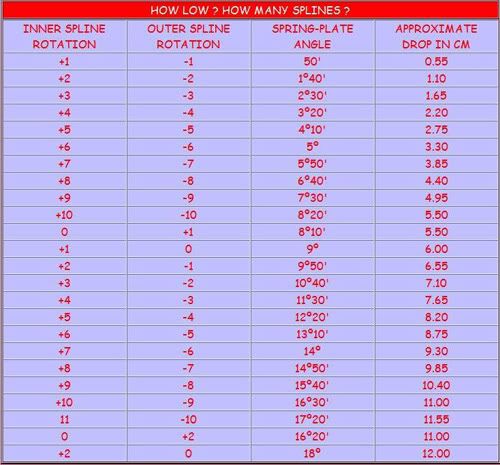
I didn't however take any measurements before the dis-assembly. Now EVERYTHING is taken apart, not trailing arms, spring plates or retainers....just the torsion bars sticking out from the housing. So here is the question....for stock height what is the degree of the spring plate? I also remember seeing a chart for lowering that someone did with the spline movement and the effect in MM. If anyone knows the correct degree's for 1" lower that would be cool too.
Rear Torsion Adjustment
-
mountainkowboy
- Posts: 341
- Joined: Fri Aug 30, 2013 12:57 pm
Rear Torsion Adjustment
71 Ghia Coupe........For Sale
71 Super-Beetle Convertible.....returning to DD status
63 IH Scout 80 (beater)

71 Super-Beetle Convertible.....returning to DD status
63 IH Scout 80 (beater)
-
Ol'fogasaurus
- Posts: 17881
- Joined: Mon Nov 13, 2006 10:17 pm
Re: Rear Torsion Adjustment
From Haynes:
Swing axle 17° w/o equalizer spring, 30-minutes +/- 50 - minutes
Swing axle w/equalizer spring 20° +/- 50-minutes
Don't ask me what the equalizer spring is as I don't know)
IRS 20°, 30-minutes +/- 50-minutes
You start this from where you place the torsion bar in at: it doesn't make any difference other then the left bar goes in the left side and vice-a-versa. The bars do "take a set" to them and installed backwards can cause them to fail.
Swing axle 17° w/o equalizer spring, 30-minutes +/- 50 - minutes
Swing axle w/equalizer spring 20° +/- 50-minutes
Don't ask me what the equalizer spring is as I don't know)
IRS 20°, 30-minutes +/- 50-minutes

You start this from where you place the torsion bar in at: it doesn't make any difference other then the left bar goes in the left side and vice-a-versa. The bars do "take a set" to them and installed backwards can cause them to fail.
-
Ol'fogasaurus
- Posts: 17881
- Joined: Mon Nov 13, 2006 10:17 pm
Re: Rear Torsion Adjustment
You didn't say what you were going to do with your car other than potential Baja and you used the word 'inexpensive' which don't always go together well.
For a street driven Baja I would think 22° to 24° would be max (viewtopic.php?t=110857&postdays=0&postorder=asc&start=0). Remember, as you add more preload the ride starts to go away but 22° I think would be a good place to start. Remember, playing with setting preload is fairly easy to do with the right tools but also dangerous so keep your head and hands way from under and around the spring plates.
If you want to raise the car up higher for more clearance at some other time you have to know the angle potential of the CVs you are going to use (http://www.blindchickenracing.com/How_t ... ts_101.htm). That wall let you know how much preload (24° to 26° is a pretty good all around setting to play with before going to a larger diameter torsion bar) you can use; remember, the swept back angle of the suspension will take about 2° out of the number of CV angle that is given. This information will also allow you to figure out how much of a notch in each spring plate you can use for more travel; there is a limit to the size of the notch also.
Also remember that anything other than the "street driven Baja" version with minimal preload 22° and under... maybe up to 24° but you will have to check that out before you put every thing back together. If the measurements don't work then you are going to need longer shock which will up the $$$ anti quite a bit. Shock absorbers are so important so don't skimp here. For check out: remove the torsion bars and put the suspension back together. Having the spring plate sit on the stop on the housing, this will give you a full hang dimension from the shock mount on the trailing arm and the shock mount eye on the torsion housing. Then have your shock sitting fully extended and measure it eye to eye. Rule of thumb is that, preferably, you want about 1/2" extra at full droop and the same at full compression so you don't damage the shock.
Advice, don't use helper springs/shocks or the type of air shock where you have fill hoses to lift the car up. The reason being that the torsion bars are not doing the major part of the work with that type of shock, the helper shocks are and they are not deigned for that.
There is so much more to this but this should get you started in some direction.
For a street driven Baja I would think 22° to 24° would be max (viewtopic.php?t=110857&postdays=0&postorder=asc&start=0). Remember, as you add more preload the ride starts to go away but 22° I think would be a good place to start. Remember, playing with setting preload is fairly easy to do with the right tools but also dangerous so keep your head and hands way from under and around the spring plates.
If you want to raise the car up higher for more clearance at some other time you have to know the angle potential of the CVs you are going to use (http://www.blindchickenracing.com/How_t ... ts_101.htm). That wall let you know how much preload (24° to 26° is a pretty good all around setting to play with before going to a larger diameter torsion bar) you can use; remember, the swept back angle of the suspension will take about 2° out of the number of CV angle that is given. This information will also allow you to figure out how much of a notch in each spring plate you can use for more travel; there is a limit to the size of the notch also.
Also remember that anything other than the "street driven Baja" version with minimal preload 22° and under... maybe up to 24° but you will have to check that out before you put every thing back together. If the measurements don't work then you are going to need longer shock which will up the $$$ anti quite a bit. Shock absorbers are so important so don't skimp here. For check out: remove the torsion bars and put the suspension back together. Having the spring plate sit on the stop on the housing, this will give you a full hang dimension from the shock mount on the trailing arm and the shock mount eye on the torsion housing. Then have your shock sitting fully extended and measure it eye to eye. Rule of thumb is that, preferably, you want about 1/2" extra at full droop and the same at full compression so you don't damage the shock.
Advice, don't use helper springs/shocks or the type of air shock where you have fill hoses to lift the car up. The reason being that the torsion bars are not doing the major part of the work with that type of shock, the helper shocks are and they are not deigned for that.
There is so much more to this but this should get you started in some direction.
-
sideshow

- Posts: 3428
- Joined: Mon Oct 27, 2003 11:00 am
Re: Rear Torsion Adjustment
"equalizer spring" AKA Z-bar or overload spring used on late swing axle cars in combination with a lighter torsion bar.
Yeah some may call it overkill, but you can't have too much overkill.
-
Ol'fogasaurus
- Posts: 17881
- Joined: Mon Nov 13, 2006 10:17 pm
Re: Rear Torsion Adjustment
viewtopic.php?t=122651 I had to look up the Z-bar; I was not familiar with it other than seeing it written down a couple of time; seeing what FJ posted about them it now makes sense. Kind of a cross (no pun intended) of several fixes covering several improvements to the swing axle suspension.sideshow wrote:"equalizer spring" AKA Z-bar or overload spring used on late swing axle cars in combination with a lighter torsion bar.
I think my statement is still worth considering.
Thanks sideshow!
Lee
-
mountainkowboy
- Posts: 341
- Joined: Fri Aug 30, 2013 12:57 pm
Re: Rear Torsion Adjustment
Didn't say anything about Baja....will be going full on German style street pounder and will be dropping the rear about an inch to start and see where I end up when I'm done. But thanks for the info.Ol'fogasaurus wrote:You didn't say what you were going to do with your car other than potential Baja and you used the word 'inexpensive' which don't always go together well.
71 Ghia Coupe........For Sale
71 Super-Beetle Convertible.....returning to DD status
63 IH Scout 80 (beater)
71 Super-Beetle Convertible.....returning to DD status
63 IH Scout 80 (beater)
-
Ol'fogasaurus
- Posts: 17881
- Joined: Mon Nov 13, 2006 10:17 pm
Re: Rear Torsion Adjustment
I don't know where I got the words "potential Baja" but I thought it was a cut and paste of a quote from you (couldn't find it in your other string so I must have got it from another persons string) so pardon my confusion. The chart is still good but not much else. 
-
Marc
- Moderator
- Posts: 23741
- Joined: Thu May 23, 2002 12:01 am
Re: Rear Torsion Adjustment
The Z-bar was conceived as last-ditch attempt to limit oversteer before giving up on the swingaxle layout. Softening the rear torsion bars required adding some sort of overload spring for when the back seat was occupied, and the Z-bar performed that function as well as operating as an anti-antiswaybar - like the aftermarket "camber compensator", it would transfer wheel loads towards the inner tire in a corner to reduce overloading the outer tire, which further reduces oversteer (and the dreaded swingaxle "tuck")...unfortunately it doesn't take effect until you're almost at the edge of control due to the slack designed into the links - shim those up and it acts more like the camber compensator. This is exactly the opposite action that is typically desired for an IRS chassis which is to be cornered hard - to reduce body roll you need to transfer the wheel load in a corner outward, for which an anti-rollbar ("swaybar") is used. For a swingaxle car the Z-bar may be an option worth considering, but it is of NO use on IRS.
As Lee stated, the stock setting for IRS is 20½°. That's the angle of the unladen springplate (before it's lifted up onto the stop) compared to the chassis. You can take the latter reading off of the doorsill - if the car's up on stands in the rear and the body's at, say, a 10° rake you'd need to add that to the springplate angle reading. Since the outer end of the bar has 44 splines and the inner has 40, one inner spline is "worth" 9° and one outer is 8.181°....one spline in opposite directions at both ends changes the angle by .818° (9° minus 8.181° = .818°).
If you're after a 1" drop, 5 splines "down" (reducing the springplate angle) on the inner end and 5 "up" on the outer should put you in the ballpark, resulting in a springplate angle of ~16½°. You'll need to reassemble and drive it at least around the block to settle in before a bumper-height measurement will be meaningful.
As Lee stated, the stock setting for IRS is 20½°. That's the angle of the unladen springplate (before it's lifted up onto the stop) compared to the chassis. You can take the latter reading off of the doorsill - if the car's up on stands in the rear and the body's at, say, a 10° rake you'd need to add that to the springplate angle reading. Since the outer end of the bar has 44 splines and the inner has 40, one inner spline is "worth" 9° and one outer is 8.181°....one spline in opposite directions at both ends changes the angle by .818° (9° minus 8.181° = .818°).
If you're after a 1" drop, 5 splines "down" (reducing the springplate angle) on the inner end and 5 "up" on the outer should put you in the ballpark, resulting in a springplate angle of ~16½°. You'll need to reassemble and drive it at least around the block to settle in before a bumper-height measurement will be meaningful.
That was chasecarlson34, who's looking to buy a Standard that he hopes to eventually turn into a Baja. viewtopic.php?f=11&t=144043Ol'fogasaurus wrote:I don't know where I got the words "potential Baja"...
-
mountainkowboy
- Posts: 341
- Joined: Fri Aug 30, 2013 12:57 pm
Re: Rear Torsion Adjustment
Thanks Marc, I will be hopefully doing that tomorrow. Along with battening down the hatches here for our coming week of sub-freezing temps......Brrrrrrrrrr!
2nd question, and I cant seem to find the info......trailing arms.....torque before test drive? I mean on the ground with full weight on the suspension to prevent any bushing preload, or doesn't it matter?
2nd question, and I cant seem to find the info......trailing arms.....torque before test drive? I mean on the ground with full weight on the suspension to prevent any bushing preload, or doesn't it matter?
71 Ghia Coupe........For Sale
71 Super-Beetle Convertible.....returning to DD status
63 IH Scout 80 (beater)
71 Super-Beetle Convertible.....returning to DD status
63 IH Scout 80 (beater)
-
Marc
- Moderator
- Posts: 23741
- Joined: Thu May 23, 2002 12:01 am
Re: Rear Torsion Adjustment
The bolts which hold the arms to the springplates have a little bit of slop in the holes, and where they're at when tightened actually has a slight effect on the final camber, but ordinarily just doing both sides the same is good enough. Some try to find the midpoint; I prefer to lift up lightly on the arm as I tighten the springplate bolts but it's not a big deal.
I've never bothered to go to the trouble to load the suspension before tightening the cover bolts - as long as you don't tighten them until after the arm is above the stop, the bushings will be fairly close to "home" anyway...but that's why I said drive it around the block, to let the bushings settle in, before measuring the ride height. If you lube the bushings up with some talcum powder they'll slide easier and be less prone to squeaking.
What have you got to pull the control arm/springplate up until it's past the stop? There's a special tool made for the job, basically just a Bug jack with some parts rearranged and a hook welded on, or you can use a floor jack on the arm with a chain from the jack frame up to the shock tower. There's also an aftermarket tool that uses a length of all-thread an a big wingnut. Another trick is to bolt another springplate on to increase the leverage and jack it into place before attaching the control arm - the IRS plates are only about half the length of swingaxle so the extra length helps when using the floorjack method.
Big C-clamps are good to have handy, they can be used to draw the plate over the stop and hold it there while you tighten things.
Even with the springplate "dangling" below the stop you may find it tough to get the cover lined up well enough to get the bolts started, and working in the cold will only make it worse...I usually start with a couple of longer bolts in opposite corners to line them up well enough to get the other two started, then take the long ones out one at a time and replace them with short ones. If you have some m10x1.5mm studs & nuts around, they work great too (since you can stack washers/bigger nuts/sockets on them to dial in their effective length). Tip: the 14mm-head bolts from the wheel bearing covers are slightly longer and can come in handy during cover installation. You can use a prybar to help line up the bolt holes too - do what you have to in order to avoid cross-threading. Once you have all four bolts started by several threads you can lift the springplate; if you try to lift the springplate and then start the bolts you'll find that's far more difficult.
https://encrypted-tbn0.gstatic.com/imag ... 3sJieKtOoV
https://encrypted-tbn1.gstatic.com/imag ... rM7n9GKr_b
I've never bothered to go to the trouble to load the suspension before tightening the cover bolts - as long as you don't tighten them until after the arm is above the stop, the bushings will be fairly close to "home" anyway...but that's why I said drive it around the block, to let the bushings settle in, before measuring the ride height. If you lube the bushings up with some talcum powder they'll slide easier and be less prone to squeaking.
What have you got to pull the control arm/springplate up until it's past the stop? There's a special tool made for the job, basically just a Bug jack with some parts rearranged and a hook welded on, or you can use a floor jack on the arm with a chain from the jack frame up to the shock tower. There's also an aftermarket tool that uses a length of all-thread an a big wingnut. Another trick is to bolt another springplate on to increase the leverage and jack it into place before attaching the control arm - the IRS plates are only about half the length of swingaxle so the extra length helps when using the floorjack method.
Big C-clamps are good to have handy, they can be used to draw the plate over the stop and hold it there while you tighten things.
Even with the springplate "dangling" below the stop you may find it tough to get the cover lined up well enough to get the bolts started, and working in the cold will only make it worse...I usually start with a couple of longer bolts in opposite corners to line them up well enough to get the other two started, then take the long ones out one at a time and replace them with short ones. If you have some m10x1.5mm studs & nuts around, they work great too (since you can stack washers/bigger nuts/sockets on them to dial in their effective length). Tip: the 14mm-head bolts from the wheel bearing covers are slightly longer and can come in handy during cover installation. You can use a prybar to help line up the bolt holes too - do what you have to in order to avoid cross-threading. Once you have all four bolts started by several threads you can lift the springplate; if you try to lift the springplate and then start the bolts you'll find that's far more difficult.
https://encrypted-tbn0.gstatic.com/imag ... 3sJieKtOoV
https://encrypted-tbn1.gstatic.com/imag ... rM7n9GKr_b
-
mountainkowboy
- Posts: 341
- Joined: Fri Aug 30, 2013 12:57 pm
Re: Rear Torsion Adjustment
Thanks
71 Ghia Coupe........For Sale
71 Super-Beetle Convertible.....returning to DD status
63 IH Scout 80 (beater)
71 Super-Beetle Convertible.....returning to DD status
63 IH Scout 80 (beater)
-
aussiebug
- Posts: 1520
- Joined: Wed Mar 07, 2001 12:01 am
Re: Rear Torsion Adjustment
Marc said...
>If you're after a 1" drop, 5 splines "down" (reducing the springplate angle) on the inner end and 5 "up" on the outer should put you in the ballpark, resulting in a springplate angle of ~16½°.<
Marc, in my experience, each one-up-one-down rotation of the splines results in about 1/2" change in height of the rear suspension. So two "rotations" would get around 1 inch change in the suspension height.
Mountainkoboy
If you are lowering the rear suspension so you end up with a negative camber on the rear wheels, you will be running the rear wheel bearings dry. They rely on a small positive camber to maintain a small pool of gearbox oil behind the wheel bearings - it's the only lubrication they get.
And when Marc says to use talcum powder on the big rubber bushings he's quite right, but make sure it's REAL talcum, not the corn-flour substitute they use in baby powder these days. Using corn flour will result in water absorption and that will lead to squeaks at best or rust at worst.
>If you're after a 1" drop, 5 splines "down" (reducing the springplate angle) on the inner end and 5 "up" on the outer should put you in the ballpark, resulting in a springplate angle of ~16½°.<
Marc, in my experience, each one-up-one-down rotation of the splines results in about 1/2" change in height of the rear suspension. So two "rotations" would get around 1 inch change in the suspension height.
Mountainkoboy
If you are lowering the rear suspension so you end up with a negative camber on the rear wheels, you will be running the rear wheel bearings dry. They rely on a small positive camber to maintain a small pool of gearbox oil behind the wheel bearings - it's the only lubrication they get.
And when Marc says to use talcum powder on the big rubber bushings he's quite right, but make sure it's REAL talcum, not the corn-flour substitute they use in baby powder these days. Using corn flour will result in water absorption and that will lead to squeaks at best or rust at worst.
Regards
Rob
Rob and Dave's aircooled VW pages
Repairs and Maintenance for the home mechanic
www.vw-resource.com
Rob
Rob and Dave's aircooled VW pages
Repairs and Maintenance for the home mechanic
www.vw-resource.com
-
Marc
- Moderator
- Posts: 23741
- Joined: Thu May 23, 2002 12:01 am
Re: Rear Torsion Adjustment
Our experiences diverge significantly. Of course it depends upon the torsion bar diameter and length, the car weight, and the wheel offset, but on an IRS Convertible I'd expect it to be closer to half of those numbers.aussiebug wrote:Marc, in my experience, each one-up-one-down rotation of the splines results in about 1/2" change in height of the rear suspension. So two "rotations" would get around 1 inch change in the suspension height.
True for swingaxle, but the car in question is IRS. My son tells me that someone's found a sealed, grease-lubed bearing that can be used on "slammed" swingaxle cars in place of the OEM type, BTW. Timken 306-FF or SKF 6306-2RSJ. I wouldn't expect it to live as long as the OEM part on a stock-height car, but it should be a big improvement for a lowered swingaxle.aussiebug wrote:If you are lowering the rear suspension so you end up with a negative camber on the rear wheels, you will be running the rear wheel bearings dry. They rely on a small positive camber to maintain a small pool of gearbox oil behind the wheel bearings - it's the only lubrication they get...