I'd advise against that - drums are made of gray pearlitic cast iron (or in the case of Brazilian drums, coffee-bean husks) which isn't all that strong and relies a lot upon the integrity of the casting to prevent cracking. If you're like me and think that strength is more important than a slight increase in weight, start with a disk-brake rotor instead and just cut off the friction area, that'll leave you with a "hub" that's every bit as strong as an unaltered part.Ol'fogasaurus wrote:...I used a stock front drum and turned it down on a lathe. It used to be pretty common to do: you chuck an old used brake drum up on a lathe making sure things are square then start cutting the area of the drum off that you are not going to use and staying away from the wheel contact area. Many years ago I saw a really neat set of hubs made using a brake drum but instead of just turning the brake contact area off they also went down and removed the web area between the stiffening flanges on the drum. Looked very hippy art like but I just don't know how strong it was...
Noob, many questions
-
Marc
- Moderator
- Posts: 23741
- Joined: Thu May 23, 2002 12:01 am
Re: Noob, many questions
-
Ol'fogasaurus
- Posts: 17881
- Joined: Mon Nov 13, 2006 10:17 pm
Re: Noob, many questions
There you go! Another better answer.
-
jakekrupa
- Posts: 11
- Joined: Thu Aug 14, 2014 5:22 pm
Re: Noob, many questions
This is from TheSamba member, dustymohave: those are "spindle mount" wheels. Fine for sand dunes and deep mud. For woods trails and street, you should have front brakes. You remove those wheels and the bearings which are light pressed into them, you remove the dust cap and the nut inside. This leaves a bare VW spindle. Then you need VW wheel bearings and backing plates, shoes and drums for a 1965 or earlier Bug. That is what the whole front "Kingpin" (aka "Linkpin") front suspension assembly is from. Since the car has a strong rear weight bias, the standard VW brake setup will cause the front brakes to lock up. loss of control follows immediately. This is even worse on dirt than on pavement. The car does NOT need strong front brakes. It needs front brakes which are not as strong as the rears. This can be achieved by putting 1968 and later REAR wheel cylinders on the fronts. They bolt right on and are a perfect fit. But since they are 17mm cylinders instead of the 22mm cylinders normal for the fronts, they produce less braking effect. There are disc brake conversion kits for these spindles, but they are intended for street use and have weak hubs easy to break offroad and are difficult to adjust the brake bias with. I recommend the early drums. You can replace the wheel lug bolts with pressed-in studs and matching nuts from BugPack. You need to drill the holes out to 37/64 and press the studs in.
I dont want brakes up front, I only need the hub.
Brakes feel solid at pedal. Cylinders are not higher than the cutters nor master cylinder. All lines are SS. no rubber at all.
Thanks for the links/insight on the cutter set-up. I really dont think I will be using them at all though. The seats can not be moved further out and the cutters themselves are at their longest reach point beside the shifter, i can not move it forward anymore.
So i just take off the wheels and it will leave the bare spindle, then i get a drum, basically re-work it into a plate with studs on it, and im ready to go? How REALLY weak are the KP spindles? Will they snap if i go trailing?
The right wheel has a TERRIBLE wobble, and the left one is okay-ish. Im pretty sure both of the wheels are bent, but can anything else be making the WHOLE wheel wobble like hell or am I okay?
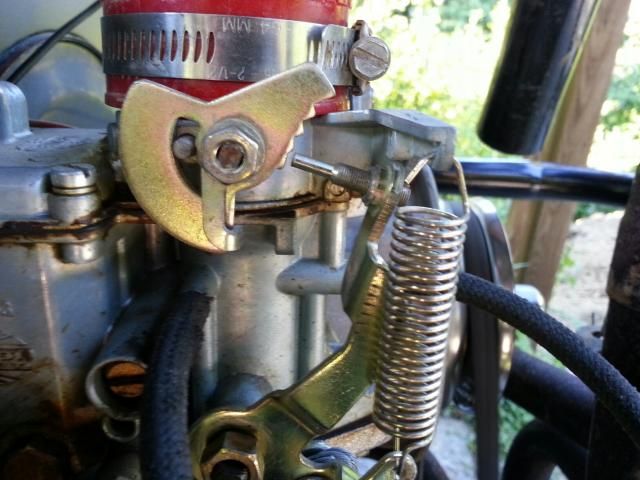
Pic of the carb, when fully warm. Drove it again today. You have to give it a decent amount of throttle in the beginning of the gear to, i guess, "engage" the carb to allow itself for you to go balls to the wall. 4th gear ive found is really long, deff a highway gear.
Another question, tach comes in tmrw. What is the absolute max redline I can take this at? Worth it to buy a rev-limiting rotor?
I dont want brakes up front, I only need the hub.
Brakes feel solid at pedal. Cylinders are not higher than the cutters nor master cylinder. All lines are SS. no rubber at all.
Thanks for the links/insight on the cutter set-up. I really dont think I will be using them at all though. The seats can not be moved further out and the cutters themselves are at their longest reach point beside the shifter, i can not move it forward anymore.
So i just take off the wheels and it will leave the bare spindle, then i get a drum, basically re-work it into a plate with studs on it, and im ready to go? How REALLY weak are the KP spindles? Will they snap if i go trailing?
The right wheel has a TERRIBLE wobble, and the left one is okay-ish. Im pretty sure both of the wheels are bent, but can anything else be making the WHOLE wheel wobble like hell or am I okay?
Pic of the carb, when fully warm. Drove it again today. You have to give it a decent amount of throttle in the beginning of the gear to, i guess, "engage" the carb to allow itself for you to go balls to the wall. 4th gear ive found is really long, deff a highway gear.

Another question, tach comes in tmrw. What is the absolute max redline I can take this at? Worth it to buy a rev-limiting rotor?
-
Marc
- Moderator
- Posts: 23741
- Joined: Thu May 23, 2002 12:01 am
Re: Noob, many questions
We don't know enough about what's in there to say what the redline might be...but if we assume that it has a stock, non-counterweighted crankshaft I'd advise shifting by 5000 (by then the carb's probably strangling it anyway) and never exceeding 5500 - that's where the stock crank starts to flex and pound the bearings in the case. If you still have stock rockerarm assemblies with wavy washers and spring clips, those are only reliable up to ~4500 but generally the damage if they fail isn't too severe.
I would think that you'd be OK without the rev-limiting rotor until you get more breathing on there - right now you're probably only in danger of exceeding 5500 if you downshift at too high of a speed, and a rev-limiter doesn't protect against that.
When the choke is wide open the fast-idle cam should be a bit more CCW than shown in the photo - your choke is either set too "rich" or the shaft is bent/binding. Take the aircleaner off and look at the choke plate - it should be standing straight up when warm, and if you hold the throttle partway open so the screw doesn't touch the fast-idle cam and diddle the choke it should snap freely back to vertical.
To adjust, loosen the three screws that secure the heating element retaining ring and twist the element (CW as you view it from the RH side) a little to "lean" the choke setting, then snug the screws back down (the choke must have good contact with the carb to complete the electrical circuit, if resistance develops it'll take longer to turn off).
If the choke shaft is binding, try working it side-to-side a little (by tapping the end lightly to shift it to the right, then prying it back to the left with the tip of a screwdriver) until if moves freely. A little penetrating oil where the shaft meets the bushing in the carb top may be in order, especially if it's been left out in the rain. 95% of the time no further surgery is needed to cure a sticky choke.
Except in the dead of winter you don't really need a choke all that much, so when in doubt err on the "lean" side. Generally, when everything's stone cold and you open the throttle slightly to "arm" the choke, you do not want it to go all the way shut....~¼" gap at the edge of the plate is usually good.
I would think that you'd be OK without the rev-limiting rotor until you get more breathing on there - right now you're probably only in danger of exceeding 5500 if you downshift at too high of a speed, and a rev-limiter doesn't protect against that.
When the choke is wide open the fast-idle cam should be a bit more CCW than shown in the photo - your choke is either set too "rich" or the shaft is bent/binding. Take the aircleaner off and look at the choke plate - it should be standing straight up when warm, and if you hold the throttle partway open so the screw doesn't touch the fast-idle cam and diddle the choke it should snap freely back to vertical.
To adjust, loosen the three screws that secure the heating element retaining ring and twist the element (CW as you view it from the RH side) a little to "lean" the choke setting, then snug the screws back down (the choke must have good contact with the carb to complete the electrical circuit, if resistance develops it'll take longer to turn off).
If the choke shaft is binding, try working it side-to-side a little (by tapping the end lightly to shift it to the right, then prying it back to the left with the tip of a screwdriver) until if moves freely. A little penetrating oil where the shaft meets the bushing in the carb top may be in order, especially if it's been left out in the rain. 95% of the time no further surgery is needed to cure a sticky choke.
Except in the dead of winter you don't really need a choke all that much, so when in doubt err on the "lean" side. Generally, when everything's stone cold and you open the throttle slightly to "arm" the choke, you do not want it to go all the way shut....~¼" gap at the edge of the plate is usually good.
-
Ol'fogasaurus
- Posts: 17881
- Joined: Mon Nov 13, 2006 10:17 pm
Re: Noob, many questions
Dustymohave is also a well respected contributor here. I'm surprised a bit about the deep mud use of them, maybe it is mud bogging that he is talking about as doing nasty's' in the mud can also put some serious side loading on the spindle mounts. They just aren't designed to ricochet off stuff.jakekrupa wrote:This is from TheSamba member, dustymohave: those are "spindle mount" wheels. Fine for sand dunes and deep mud. For woods trails and street, you should have front brakes. You remove those wheels and the bearings which are light pressed into them, you remove the dust cap and the nut inside. This leaves a bare VW spindle. Then you need VW wheel bearings and backing plates, shoes and drums for a 1965 or earlier Bug. That is what the whole front "Kingpin" (aka "Linkpin") front suspension assembly is from. Since the car has a strong rear weight bias, the standard VW brake setup will cause the front brakes to lock up. loss of control follows immediately. This is even worse on dirt than on pavement. The car does NOT need strong front brakes. It needs front brakes which are not as strong as the rears. This can be achieved by putting 1968 and later REAR wheel cylinders on the fronts. They bolt right on and are a perfect fit. But since they are 17mm cylinders instead of the 22mm cylinders normal for the fronts, they produce less braking effect. There are disc brake conversion kits for these spindles, but they are intended for street use and have weak hubs easy to break offroad and are difficult to adjust the brake bias with. I recommend the early drums. You can replace the wheel lug bolts with pressed-in studs and matching nuts from BugPack. You need to drill the holes out to 37/64 and press the studs in.
I dont want brakes up front, I only need the hub.
Brakes feel solid at pedal. Cylinders are not higher than the cutters nor master cylinder. All lines are SS. no rubber at all.
Thanks for the links/insight on the cutter set-up. I really dont think I will be using them at all though. The seats can not be moved further out and the cutters themselves are at their longest reach point beside the shifter, i can not move it forward anymore.
So i just take off the wheels and it will leave the bare spindle, then i get a drum, basically re-work it into a plate with studs on it, and im ready to go? How REALLY weak are the KP spindles? Will they snap if i go trailing?
The right wheel has a TERRIBLE wobble, and the left one is okay-ish. Im pretty sure both of the wheels are bent, but can anything else be making the WHOLE wheel wobble like hell or am I okay?
...Drove it again today. You have to give it a decent amount of throttle in the beginning of the gear to, i guess, "engage" the carb to allow itself for you to go balls to the wall. 4th gear ive found is really long, deff a highway gear.
Another question, tach comes in tmrw. What is the absolute max redline I can take this at? Worth it to buy a rev-limiting rotor?

What dusty is talking about is also well documented I Baja Bugs & Buggies by the late Jeff Hibbard. Under normal situations the information that he gave you is the best out there.... Honestly. Dusty has a long history with off-road racing and Marc is an older competitor in several forms of racing. I rely on both of them and several others here for information and opinions.
You must have some soft lines in the rear some place, usually at or around the pivot points of the trailing arms. If not then you could very possibly have the potential of metal fatigue which isn't uncommon with CRES/SS.
Do me a favor, try bleeding the system one more time but try it this way:
after jacking both wheels off the ground and putting your rail buggy on jack stands; adjust both rear brake assemblies as tight as possible (within reason that is); this centers the semi-floating brake shoes in the drums then move on to bleeding w/out backing off the adjusters.
Next bleed the brakes as you would but do not bleed using the cutter handles, leave them alone for the time being. After the system is purged and the fluid comes out clear making sure you keep the master cylinder reservoir full (I forgot to ask, single for double master cylinder and are you using a bus master cylinder if it is a single. If it is a double master cylinder then what year as I think there might be two bore sizes and you want the larger bore size for drum brakes), then you can back off on the adjusters until when you rotate the tire you can hear the brake shoes lightly dragging on the drums.
Try the brakes and see how they feel. If they are fine now try the cutters one at a time. Are they solid or soft. Is one side solid and the other soft or are they both soft? If one of both handles pull soft them there is another bleed you can do. (this is the old way of doing it but the brake manufacturers don't think you need to do this anymore). The same procedure as before but when the pedal hits the floor you then pull on that side's cutter handle. When it stops you tell the other person to close the bleeder screw then... still holding back on the cutter handle you pump the cutter cylinder back to its resting place. Fill the reservoir again and repeat if necessary looking for bubbles and dark fluid; when that side is OK then start on the other side. If that doesn't fix it, as it is the old way of bleeding with cutters, then there is a problem and it probably isn't with the cutter... I think. Also remember that there are two bore sizes with the cutters too and the wrong size can give a soft pedal... as I remember.
Can you get me a picture of the spindle mounts. It is going to be hard to tell if the outer bearing is stock VW King & link bearings or sealed bearings as both are available. It is even possible that some of the rims had the capability to use either. the inner bearing and seal usually are stock VW King & link parts.
The only time you want the wheel to wobble is when you are trying to take if off. Try this: lift the front end off the ground and put it on stands. Grab the top of the wheel and the bottom of the wheel and push/pull both grabbing points. Does the wheel have slop in it. If there is you should be able to see, feel and hear it. Also look at the link pin on the inside of the spindle and the king pin to see if there is slop there too. Try it again from the sides and look for slop in the wheel and the steering linkage. If everything is tight then spin the wheel and look for the wobble. If you get wobble from spinning look to see if it is only towards the outside or if the hub is also wobbling. If it is only the outer part of the wheel then I would assume that the wheel is bent most likely from bouncing off something. (this is a bit of over kill but it is part of checking things out so you know just what you have and the condition of it)
If there is movement in the king pin and or link pin then you need to have new bushings pressed in the spindle and then reamed to fit the king pin. The link pin is going to have either 8 or 10 shims at each bolt that need to be moved around (do not remove/delete any as the number balance at each bolt has to be kept) to get the right alignment. If you don't have a good VW manual (Bentleys is probably the best but Haynes should do in a pinch now is the time to get one).
If you have a mind set on the hubs then follow what Marc suggested first then the way I showed. Marc's way was should be stronger hence safer.
If you look at the driver's side spindle the spindle's bung is hollow; this if for the speedometer's cable to go through. In the book I mentioned, Jeff gives directions to putting a bolt in place to strengthen it up. I have heard that it doesn't work that well from some people but I have no clue yea or neh. If you are really concerned then there are combo spindles but that opens up another can of potentially expensive worms but it is stronger too so that is a plus. I guess it kind of depends on how hard you are driving it I guess.
On the second picture of the cutters did you notice what he had done to the handles? That was part of the option I was talking about... make the handles fit what you need not using what you are given and making due with that.
This should keep you busy for a few minutes any way. I hope you don't find any big problems.
Lee
Edit, if you can find them, the backing plates being the catch here... hard to find and they are usually expensive when they show up, Type 3 rear brakes are very good to use. The shoes are wider giving more surface for braking. Swapping wheel cylinder front to back will help also.