BRAKES
Preface note. The VW Ghia is such a light car that it's brake demands are only moderate, and most of the extremes in power assisit, brake proportioning, etc., are just not that critical.
 BRAKE BASICS ON REAR-ENGINE CARS
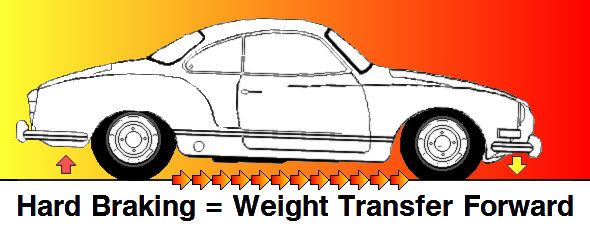
The rear-engine car, with more than half its weight in the rear, has a distinct braking advantage. As the weight transfers forward in braking, all four wheels are loaded, making the rear brakes work harder than on a front-engined, front-heavy car.
Even though rear-engined, in hard braking, about 70% of the total VW or Porsche braking effort is still borne by the front brakes!
Front-engined cars obviously overwork their front brakes, which might explain why the Ghia can get by with proportionally smaller brakes all the way around, than say, the Mustang beside it. Smaller, lighter, brakes mean less unsprung weight as well.
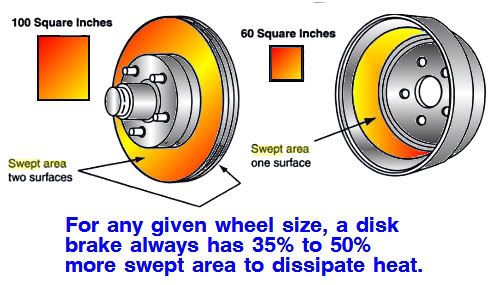 THE SWEPT AREA
Also, with the Ghia being a light car to begin with, the factor of "swept-area" versus weight comes into play. The swept area is the friction area on a disk or drum that contacts the brake pad or shoe.
Generally speaking, the larger the swept area, the better the brakes work. Disk brakes have an advantage, as they have a swept area on both sides, whereas drums are considered to have a single area, even through there are two shoes.
VW's have a very good swept area to vehicle weight ratio, in fact, falling even today into the performance brake range. Actually, a 1972 Ghia, box stock, could stop in a shorter distance from 70mph than a 911.
The problem was in constantly repeating the stop, and increasing braking efficiency over 70mph. Which can be done.
STOCK BRAKES? NOT SO BAD
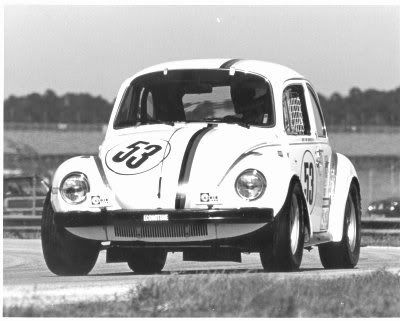
We learned something useful about VW brakes in our 1973 Herbie the Super Bug foray into IMSA B-Sedan Racing in 1976. They are better than expected.
The B-Sedan rules didn't allow for us to change the brakes (except pad or shoe material) so we had to run stock. For the 1973 Super Bug, that meant 2-pin ATE calipers and solid 10.9-inch (277mm) rotors (9.5mm thickness), same as the Ghias had, and rear 9-inch drum brakes, same as on the contemporary Bugs and Ghias.
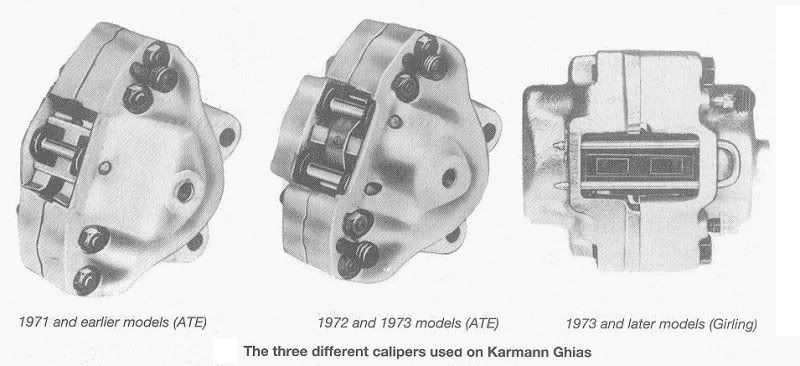
The AT of ATE, incidentally, means Alfred Teves, the engineer who created the ATE company in Germany way back in 1906. He pioneered hydraulic brakes in Europe. For the Ghia, there are 3 different styles of calipers using 3 different shapes of pads. Left to right:
1-pin pad ATE early (1967-71)
2-pin pad ATE (1972-3 year)
U-pin pad Girling (1973-4 year) pad not interchangeable with 1972 ATE.
The twin pistons are 40mm, either ATE or Girling.
The ATE caliper used in 1972 became widely copied (today it is VARGA/TRW) because it used a better pad size than the 67-71 type, and did not require dismounting the caliper to change the pads like the Girling did. Easier for maintenance and racing.
THE REAR DRUM SLAVE CYLINDER UPGRADE
From 1968, the Bug and Ghia had 17.5mm rear slave cylinders. The larger 19.05mm rear slave cylinder from the 1958-1967 models is a direct bolt-on. So is the 22.2mm front slave cylinder from the 1965 or later Bug.
But don't just go out and slap on larger rear cylinders. They do increase rear braking power, but they do not necessarily improve overall braking. They can cause rear wheel lockup if the front brake power is not also increased. Brake proportioning comes into play here. Just read on.
BETTER BRAKE SHOES
Heavy duty or competition linings are available for drum brake shoes. Brake & clutch shops that do their own relining can adhere or rivet upgraded linings to your shoes. Back in the day I used to have a local shop do my shoes and clutches before really good aftermarket parts were available.
Grooved linings are better than solid, as they act somewhat like drilled disks or drums to expel heat and incandescent boundary-layer gasses from red-hot racing brakes.
We currently have Mintex rear shoes on 53. The cheap stock shoes that came on the car when we took delivery of it, even though still good, were replaced in February 2006, after seen constant use since August 2002.
BETTER BRAKE PADS
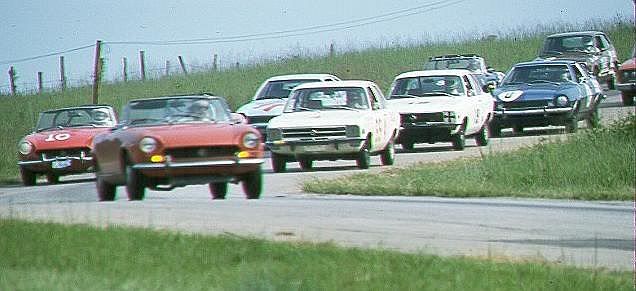 SCCA Showroom Stock Race, Virginia International Speedway August 1974. The white Opel Ascona with the Maltese Cross over the headlights is driven by Dr. Jim Roberts, who won the race in class and overall. Showroom stock meant just that -- cars off the showroom floor.
A set of stock pads on our Showroom Stock Opel Ascona could be burned totally away in one 10-lap race at Road Atlanta. but that was with Dr. Jim Roberts driving, and he won races. Roberts, who started SCCA racing in 1973, has an impressive record; four SCCA national championships, five HSR championships, and a number of IMSA wins. As a matter of fact, at last count Roberts has 230 wins out of 316 starts, and 51 consecutive first places. Wrenching for Roberts was a good place to start racing.
Back then, with just aggressive street use I could wear through a set of stock front pads in 3000 miles on my 1972 street/autocross/rally Ghia coupe. That is, until I discovered Repco semimetallic pads. They stopped me a great deal quicker, and didn't wear nearly so fast. The Repco's were what we'd call "light track" today, but in 1976 we were glad to get them.
We ran Repco pads on Herbie's front disks, and stock standard shoes on the rear drums. The amazing thing was Herbie's brakes were good. And the rear shoes never wore. Of all Herbie's development problems, brakes were not one of them.
Now, fast forward from 1976 to 2002, and the 1970 Ghia we bought to build into the new 53. The brake hardware is the same as Herbie's, front and rear. But now, brake pad material has greatly advanced.
On our Ghia, the original ATE calipers had been replaced by the VARGAS copies. But that wasn't a problem. To begin, I bought a pair of German-made Sebro cross-drilled rotors, something we never had for Herbie.
53's original mission was to do battle in autocrosses, and you don't need much in the way of fancy brake pads for that. We ran stock pads until our first serious track day at the local Talladega Gran Prix in June 2003. Well driven 911's ran 1:12 laps at the TGP then, and in our developmental 1600cc configuration, on street tires, Jim Roberts posted a 1:17.
http://www.youtube.com/watch?v=w0_uceU6EUs&feature=user
When it came Barret's turn to drive (see short video), he ran 1:18's, but after ten minutes of pushing it, the stock pads gave up and the brakes began to seriously fade.
The answer proved to be Porterfield carbon kevlar Pads.
http://www.lpiracing.com/livper/porterfield_1.html
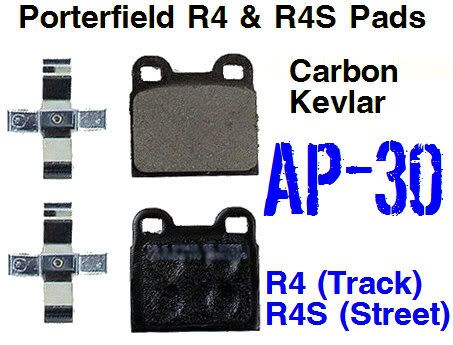
R4 is track only. R4S is for street and light track.
These pads alone fixed the fade problem. No matter the track, from the high-speed Road Atlanta to the tight, brake-intensive Barber Motorsports course, we never experienced fade again. Stock master and slave cylinders, rear drums, shoes, and all.
BRAKE HARDWARE UPGRADES
Lots of companies offer front and rear disk brake upgrades. Airkewld, run by Pete Skiba, has some of the best brake kits.
http://www.airkewld.com/pages/welcome.php
Pete provided our studded and cross-drilled rotors when we replaced the Sebros, and offered his best Bad Brakes kit for our Carrera Panamericana Ghia, but we stuck to VARGA caliper for both 53 and 261. Our decision to stick close to stock was simple. No doubt Pete's brakes are ultimately better, but our brake combo has been working great and we haven't yet reached its limit.
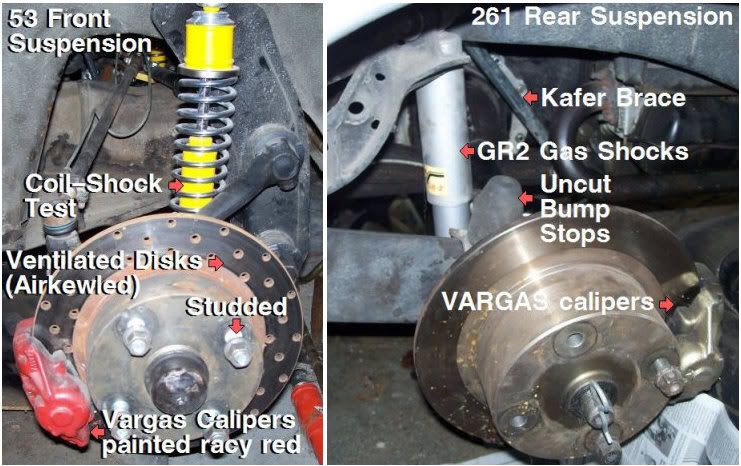
Above: VARGA calipers can be painted racy red if you have the time and a sense of humor. The four-wheel disk brake kit for 261 came from Joe Chirco
http://www.chircoestore.com and got our Carrera drivers Barret Camper and Justin Broughton home alive from the 8000 ft. mountain road races.
An important side note is there is a possible complication when installing a disk conversion on a swing axle VW. Remember that on a swing axle, the axle tube is rigid and the brake bracket is bolted to the hub. But, the axle inside the axle tube moves in and out slightly.
Now, your rotor is fixed to the moving axle, and your caliper to the rigidly mounted axle hub!
As you drive, the rotor can shift in and out just enough to pound the pads back (termed knock-back), and when you step on the brakes, you will have to pump them a couple of fast exciting times to make anything happen.
The fix for this is to limit axle travel by shimming the axle bearing "float." Joe Chirco advises this:
The rear axle bearing float needs to be minimized while maintaining sufficient compression on the caliper bracket. There are two ways to accomplish this. One method is to shim the bearing to the correct float. The other method is by machining the bearing retainer cap to size. Some disc kits come with various thickness bearing shims and will function just fine.
By the way, we ran Porterfield R4S pads on 261's front rotors and stock pads on the rear. Worked great.
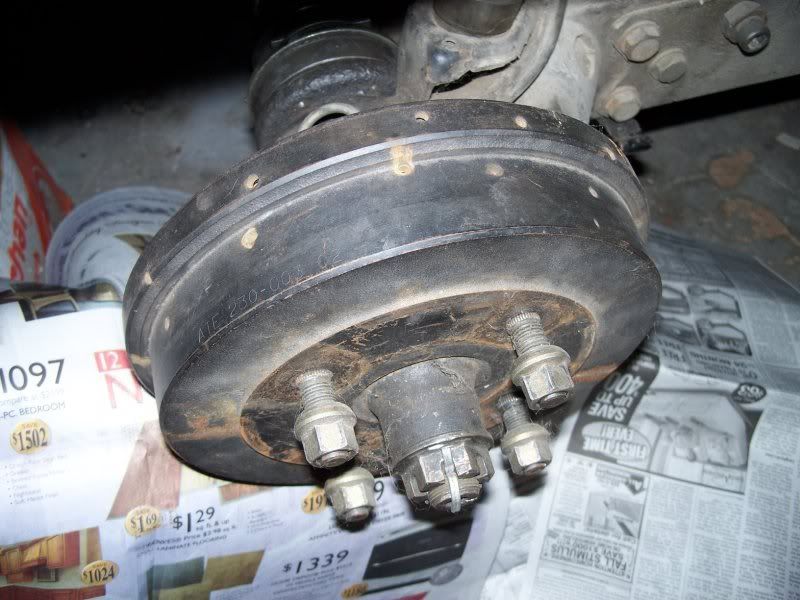 CROSS-DRILLED ROTORS, DRILLED DRUMS
The holes in disks or drums are not just for cooling, as they might appear. Mainly, they release the gasses created by superheated brake pads and shoes. These gasses act as a lubricant boundary layer between the brake friction material and metal rotor or drum. Our rear drums were drilled by
http://www.chtopping.com
Our Herbie never had drilled rear drums.
Our drilled Ghia drums have worked great, and the reason I kept rear drums on the Ghia in the first place was it started competition life as an autocross car, and I wanted an operational handbrake. Drilling the drums were an experiment that worked, and while I do not feel the need to change over to rear disks to improve braking, I intend to eventually change over for easier brake service and inspection at the track. Track cars don't need hand brakes. 261 didn't have them, and it survived Mexico on plastic wheel chocks.
MASTER CYLINDERS
We run a stock Ghia master cylinder, and it works for us. We've used both German and Brazilian, without being able to notice any difference. Of course, remember 53 is a race car, and gets its parts replaced more frequently than a street car, so the durability differences between parts sources does not always affect us in the short term.
The VW dual-circuit master cylinder for disk/drum is 19.05 mm inside diameter. The early 911 m/c was 17mm. Lots of guys have swapped later, larger 911 m/c to VW's because they bolt right up, expecting better braking.
But all a larger inside diameter m/c does is pump more fluid, and (if all else is equal) that means you have to press harder (yes harder) on the brake pedal to get the same amount of braking force. Installing a larger ID master cylinder is justified only when using different calipers with different piston sizes that require more fluid to activate them. That leads us to this:
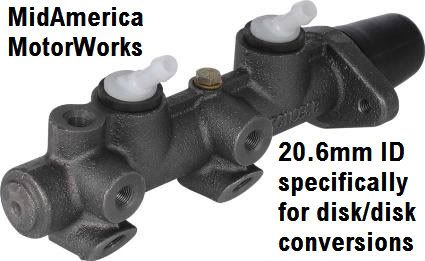
For four-wheel disk brake conversions do get the special disk/disk m/c offered by some parts houses. We have one on 261. Be aware than unlike drum brakes (and this is a simplification), disk brakes require a little residual pressure to keep the pad just barely in contact with the rotor, and the valving in the m/c provides this.
http://www.mamotorworks.com/acvw-1-0-4690.html
The master cylinder pictured here is from Mid America Motor Works and is 20.6mm ID, to provide for the extra fluid disk calipers require.
BRAKE PROPORTIONING & RESIDUAL VALVES
Traditional to serious racing is brake proportioning, meaning more or less braking effort in the front or rear. Some older setups actually had the brake pedal pushing a see-saw lever that activated two separate master cylinders, one each for the front and rear. By tilting the lever, you got more or less push on one of the two master cylinders, and changed how the car braked.
For street safety, manufacturers learned to provide hydraulic brake proportioning valves (or even mechanical means) to the rear brakes on trucks, vans, etc.
The single, nonadjustable factory valve became more and more common on vehicles of all types. For instance, the 914 came with such a valve. Some drivers complain they can feel the addition of a valve in the brake system because its changes the pedal feedback once it kicks in.
We used an adjustable valve on Herbie, thinking it to be necessary as Herbie was a "real" race car, and ended up removing it. Our valve tended to act erratically, and once even siezed the brakes while going to the grid at Road Atlanta! We've never needed one on 53, or 261.
Residual valves (plumbed into the brake lines) are a little different.
The VW master cylinder is located (but just barely) above the height of the brakes. This is to keep fluid from siphoning back into the master cylinder when the brake pedal is released and making you have to pump the pedal the next time to brake. A residual pressure valve, specifically the 2psi type, fixes this for racing in the mountains.
The 10psi valves are for use in a drum brake system to prevent air from being sucked (via the slave cylinder) into the lines when you release the brake pedal. Common wheel cylinder designs only seal when there is pressure present. Quick release of the brake pedal can cause the seals to relax and allow air to enter the wheel cylinders. 10psi back pressure stops this. The VW disc/drum master cylinders already have internal residual pressure valves.
It's not likely you will need a residual valve but it's possible if you're mixing and matching lots of brake parts from different makers. We don't use residual valves on 53 or 261.
BRAKE FLUID
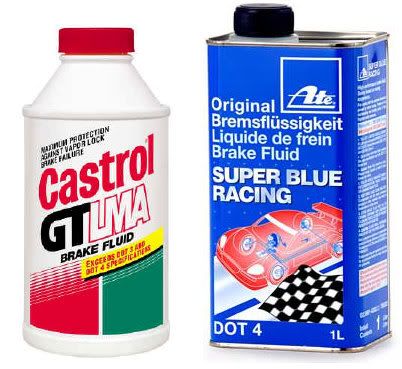
Brake fluid is made with almost no water in it, because it boils anyway when hot enough, and as it gets older and absorbs moisture, it boils quicker. The water turns to steam inside your brake system and causes vapor pockets and (understatement) erratic braking.
I like Castrol LMA (low moisture avidity) for street use, as it resists absorbing water. For street cars, replacing the brake fluid every two years is highly advisable.
In racing, you will be replacing brake fluid all the time in pre-race bleedings, repairs, parts swaps, etc.
While there is some really great and exotic fluid out there such as ATE Super Blue, we've found that our brake demands on 53 are reasonable enough that NAPA DOT 4 works very well for us.
DOT 4 (Department of Transportation) spec fluid has a minimum dry boiling point of 446 deg. F. contrasted to DOT 3 at 401 deg. F.
There is a silicone-based brake DOT 5 brake fluid with a claimed dry boiling point of 500 deg. F, but be careful. Silicone fluid cannot be mixed with standard brake fluids, so before using silicon fluid, you must completely clean and purge your brake system. Also the silicone fluid seems to many drivers to produce a soft or "spongy" feel to the brake pedal. DOT 5 fluid is seldom seen at the track but is very popular for show cars.
Next TIRES