Page 2 of 5
Re: Rear Disk Brakes Pro & Con
Posted: Wed Apr 13, 2011 9:48 pm
by Buggin_74
Bruce2 wrote:Buggin_74 wrote: I'm using the Volksconversions Australia kit which uses Fiat 124 spider calipers, so OEM quality, easy to obtain pads and parts, has a good handbrake mechanism which uses stock cables and they are perfectly balanced with the stock front discs and stock master cylinder.
I'm not sure that what Bruce said applies to all standard vs super master cylinders.
Do you know what size pistons those Fiat calipers use?
MC trivia:
AFAICT, there is a different MC for every brake configuration VW made. Up-over, we got Supers with 4 wheel drums, Standards with 4 wheel drums, and KGs with disc/drums. While the KG and Standard Bug are both Type 1s, the different front brakes meant the cars got different MCs from the factory. There were two differences. The drum MC had restriction drillings, the disc one didn't. The two had different length strokes between the two ccts.
Then the Super was different still. To differenciate it from a Standard or KG MC, they rotated the mounting flange. The bore is the same for all three, but the Super had a longer stroke for the front cct due to the larger dia wheel cylinders on the larger Super drums. Since Supers with discs had exactly the same brake parts as a KG, I would expect it's MC would have the same stroke lengths as a KG MC. Thus the only difference would be the rotated flange. (this is a guess)
Today, the KG MC is the only one we can get for Standards since it works just fine with a 4 wheel drum car. Even the Super MC works fine in a Standard. A buddy of mine had a new German Super MC leftover from his days owning a Super. Then when he built his Standard, he installed the Super MC at a funny angle. I didn't think it would bleed properly, but it did.
No idea on the Fiat piston size sorry, never had them apart.
I'm dealing with RHD so even different mastercylinder yet again.
I've never taken any notice with LHD cars but the big difference between standard and super MC here is the standards have 3 brake line ports, 1 back and 2 for each front where as the super only has 2, the front splits in the brake pipe on the frame head.
Guessing LHD are the same?
I've had a few standard bugs, the 68-70 1500 here were disc brake but the 71 on 1300 were 4 wheel drum.
There were no noticeable differences in the MC but thats not to say that A. there weren't internal differences or B. some lazy arse mechanic just used a disc brake MC on my drum bugs.
Re: Rear Disk Brakes Pro & Con
Posted: Mon Apr 18, 2011 6:06 pm
by Manny
The brackets should be on their way from Mike as we speak. Thanks a lot for your link.
Re: Rear Disk Brakes Pro & Con
Posted: Tue Apr 19, 2011 5:57 am
by Piledriver
FJCamper, I forget--- Where did you have your Mintex linings installed?
I have bought a second set of T3 rear brake shoes to get a decent lining attached.
*(before I break down and go rear disc)
Would they need actual drum dimensions to radius properly?
Re: Rear Disk Brakes Pro & Con
Posted: Tue Apr 19, 2011 11:12 am
by FJCamper
Hi Piledriver,
I bought those Mintex shoes new four or five years ago, and saved them. I do not recall which vendor offered them, but they were advertised as Mintex. I have not seen them advertised by name again.
My advice is to have a set of shoes relined locally with whatever heavy duty or racing lining they offer, and have them chamfered, radiused, and dust grooved.
The grooving actually makes the shoe fit better once radiused. Goove the material into three equal sections, with a cut about 2/3 of the way through the material, and angle the grooves so that the dust is carried to the outside of the shoe when the wheel is rolling forward in a normal fashion.
FJC
Re: Rear Disk Brakes Pro & Con
Posted: Tue Apr 26, 2011 11:57 am
by AMBROSIA
I went a similar route to the airsouls setup on mine.
I used the stock rear drums, machined them down and fitted 914 rotors over the top.
As mine is a swing axel I made up an ali adapter that bolts up behind the bearing section.
The calipers are from a passat and have a slightly larger bore than the golf/rabbit one.
I chopped down the drum backplate to retain the stock bearing seal and cover.

I used longer bolts through the hub cover and bolted the caliper mount behind.

A homemade mount for the flexi hose.

The handbrake cable is made up of a T2 inner that has the threads cut down and the rear hooks cut off.
The outer is half beetle half golf.

The Caliper adapter.


Here is the spec of the caliper mount.

I'm using a stock ate master cylinder, front disc's and calipers.
The braking is superb and has proven stable well over a 100mph.
I've been running it for 4 years now with no issues other than a leaking rear hub seal.
Re: Rear Disk Brakes Pro & Con
Posted: Wed Aug 03, 2011 1:23 pm
by Manny
Hi, Gerrelt,
Well, I duplicated your effort, got all the parts, etc.
I now have some information to add:
The bearing/seal support on the end of the swing axle had to have one flat ground to accomodate the Sharp brackets (those are a work of art. Thanks, Mike) I have another set of swingaxle tubes and they are perfectly squared. Go figure.
The drums look alike. When turned into hubs, I found one to be a lot beefier (thicker ).
The 2 mm step allows the rotor to center in the gap built into the caliper bracket. No 2mm step means a rotor not aligned where it needs to be.
The stock steel wheels won't clear the caliper. Need to find some that will clear.
Pile, the pistons are 38mm as I remember
Went back to the rear drum setup for the time being. I live in Forida and it is hurricane season; the car needs to be driveable on short notice.
Re: Rear Disk Brakes Pro & Con
Posted: Wed Aug 03, 2011 2:02 pm
by Piledriver
Slick.
I totally get the "short notice" thing, I'm a Florida native myself.
(My dad worked at the cape back in the day)
Re: Rear Disk Brakes Pro & Con
Posted: Fri Aug 05, 2011 6:59 am
by hugging corners
Gerrelt wrote:Another con with drums is that they are not self-adjusting.
I recently converted to rear disk brakes using 914 disks and VW Golf/Rabbit calipers, see:
Link
Because I am using VW golf rear calipers, high performance brake pads are probably available. I didn't check.
And it has a handbrake system.
great link. I see that you have machined a lip on the surface of rear drum housing used to bolt on Porsche's disc rotor.
Has this effected side way offset (the rotor surface to disc pads/caliper.)
I see some people fit drum cutout outside, but some inside, and then i see you show passat and golf caliper bracket which has different angle, any relation there?
Manny wrote:Hi, Gerrelt,
The 2 mm step allows the rotor to center in the gap built into the caliper bracket. No 2mm step means a rotor not aligned where it needs to be.
that's exactly what i am concerned. this might be the answer i am looking for?
Also what is needed to machine drum like that, Do i need a metal lathe, or brake cutting lathe at local machanic is fine?
again great tread. good luck
Re: Rear Disk Brakes Pro & Con
Posted: Fri Aug 05, 2011 7:59 am
by dstar5000
I can't believe someone used the word Fiat and reliable in the same sentence!

Don
Re: Rear Disk Brakes Pro & Con
Posted: Fri Aug 05, 2011 10:42 am
by raygreenwood
Piledriver wrote:FJCamper, I forget--- Where did you have your Mintex linings installed?
I have bought a second set of T3 rear brake shoes to get a decent lining attached.
*(before I break down and go rear disc)
Would they need actual drum dimensions to radius properly?
I bought Mintex type 3/4 shoes in the box several times at ESP Brake down in Deep Ellum Dallas 214-748-6386. Complete shoes not shoe material. They made a world of difference. Ray
Re: Rear Disk Brakes Pro & Con
Posted: Fri Aug 05, 2011 11:28 am
by Chris V
Dad's daily driver has received both Type III rear drums as well as 924S (good for swingaxle conversion)...along with a STD dual-circuit M/C with success - nearly equal performance and no more adjusting. I've also installed 944 rear discs to our other car (the only difference being backingplates/dust shields). Both setups are 'bolt-on' only requiring some e-brake adapters to use stock Beetle E-brake cables, available from Lanner at Vdubcustoms.(aside from a little plumbing). The Porsche stuff is easy to find different linings in as well...rebuilding is a piece of cake too.
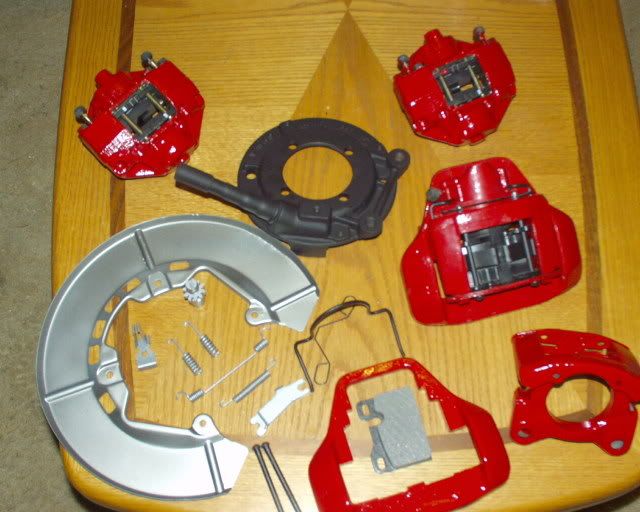
924S (next to early Type III/Type IV/replacement Ghia calipers):
http://img.photobucket.com/albums/v212/ ... 130029.jpg
Re: Rear Disk Brakes Pro & Con
Posted: Sun Aug 14, 2011 5:38 pm
by Manny
I would suggest to test fit the rotor on the hub before shaving the 2mm step. Since I found the hub thickness to be diferent on my two donor rotors.
2mm worked out fine on one hub. I'm not cutting the second hub before a test fit with the caliper bracket installed.
A lathe is the way to go. Wish I could post pictures, a thousand words take way too much space.
Re: Rear Disk Brakes Pro & Con
Posted: Mon Aug 15, 2011 8:34 am
by Marc
IMO the risk of increased failures caused by cracks originating at drilled holes outweighs any potential improvement in stopping power, whether disk or drum - but drums in particular should not be drilled, if you're after cooling the effort's better spent on venting the backing plate and ducting air to it. Modern lining materials don't outgas like those used years ago, when drilling had a purpose.
Drilled rotors will work better when wet, if that's your concern, but they need to be drilled properly (and the holes deburred & chamfered to reduce the incidence of cracking)...
Of course those who are selling drilled rotors insist that they're a "must" - otherwise why would you buy them? But it's mostly marketing hype.
Some comments from brake engineers:
Darrick Dong; Director of Motorsports at Performance Friction:
"Anyone that tells you that drilling makes the disc run cooler is smoking crack."
Wilwood Brakes:
Rotors are drilled to reduce rotating weight, an issue near and dear to racers searching for ways to minimize unsprung weight. Drilling diminishes a rotor's durability and cooling capacity."
From Waren Gilliand:
(Warren Gilliland is a well-known brake engineer in the racing industry and has more than 32 years experience in custom designing brake systems ...he became the main source for improving the brake systems on a variety of different race vehicles from midgets to Nascar Winston Cup cars.) "If you cross drill one of these vented rotors, you are creating a stress riser that will encourage the rotor to crack right through the hole. Many of the rotors available in the aftermarket are nothing more than inexpensive offshore manufactured stock replacement rotors, cross drilled to appeal to the performance market. They are not performance rotors and will have a corresponding high failure rate"
Baer Brakes:
"What are the benefits to Crossdrilling, Slotting, and Zinc-Washing my rotors? In years past, crossdrilling and/or Slotting the rotor for racing purposes was beneficial by providing a way to expel the gasses created when the bonding agents employed to manufacture the pads...However, with today's race pad technology, 'outgassing' is no longer much of a concern...Slotted surfaces are what Baer recommends for track only use. Slotted only rotors are offered as an option for any of Baer's offerings."
Grassroots Motorsports:
"Crossdrilling your rotors might look neat, but what is it really doing for you? Well, unless your car is using brake pads from the '40s and 50s, not a whole lot. Rotors were first drilled because early brake pad materials gave off gasses when heated to racing temperatures, a process known as "gassing out." ...It was an effective solution, but today's friction materials do not exhibit the some gassing out phenomenon as the early pads. Contrary to popular belief, they don't lower temperatures. (In fact, by removing weight from the rotor, they can actually cause temperatures to increase a little). These holes create stress risers that allow the rotor to crack sooner, and make a mess of brake pads--sort of like a cheese grater rubbing against them at every stop. Want more evidence? Look at NASCAR or F1. You would think that if drilling holes in the rotor was the hot ticket, these teams would be doing it...Slotting rotors, on the other hand, might be a consideration if your sanctioning body allows for it. Cutting thin slots across the face of the rotor can actually help to clean the face of the brake pads over time, helping to reduce the glazing often found during high-speed use which can lower the coefficient of friction. While there may still be a small concern over creating stress risers in the face of the rotor, if the slots are shallow and cut properly, the trade-off appears to be worth the risk. (Have you looked at a NASCAR rotor lately?)
AP Racing:
"Grooves improve 'cleaning' of the pad surfaces and result in a more consistent brake performance. Grooved discs have a longer life than cross-drilled discs."
Re: Rear Disk Brakes Pro & Con
Posted: Mon Aug 15, 2011 6:05 pm
by Bruce2
I have two sets of stock KG front rotors, one solid, one drilled. My solid rotors are on my dropped spindles, the drilled rotors are on stock spindles. When I make a road trip to Mexico, I need the ground clearance, so I swap on the stock spindles with the drilled rotors.
I can't tell any difference in braking performance between the two types of rotors, and I've switched back and forth several times over the years. The big difference is the noise. Drilled rotors make a loud hissing sound, louder with bigger holes.
I can see in a race environment the holes could initiate cracks. The rotors are getting really hot, then the cooldown time is short before the next application of the brakes.
For my car in street use, when I have the drilled rotors, I don't brake hard enough to cause the cracking. This includes many steep mountain grades, and as much as 1000 extra lbs of gear. So I don't think it's very likely that cracks will develop on a VW that is used on the street.
Re: Rear Disk Brakes Pro & Con
Posted: Tue Aug 16, 2011 10:41 am
by FJCamper
Gentlemen,
I don't disagree on the possibility/probability of drilled rotors or drums cracking, and have no problem with solid or slotted rotors. We run solid rotors on the front of our Mexico car.
But, you may remember that it was Porsche that introduced drilled rotors with the 917's for the brake pads of the day and that was 1969 onwards, not 1940's and 50's. Porsche kept the drilled rotors through the service life of the car, and then offered them on the RSR's.
If you'll look up
http://www.chtopping.com, these are the guys who drilled the drums for me. We've had them since 2002, and they've been on two different race cars now, plus one turning, and no problems. I can't speak to anyone elses' experience.
All we laymen have is observation and opinion, and mine is (good quality) drilled rotors or drums are very functional and are not for style.
That said, if I were equipping a street car, I'd use grooved or slotted rotors. I'm okay with both solid or drilled for my racers. I know Porsche did not use the drilled rotors on the 917's on a whim, even if it were just to reduce unsprung weight.
Having been there and changed brakes on racing 917's, I can tell you those rotors that cracked were so thin we knew they would crack, and we changed them out regularly. Maybe this began the legend that "drilled rotors crack."
We have used both Zimmerman and Airkewled drilled rotors on the front of our 2.2 liter car and they are VW factory thickness, with no cracks ... so far.
FJC