Page 2 of 3
Re: brake efficiency problem
Posted: Tue Apr 29, 2014 4:41 pm
by jhoefer
davegeezzer008 wrote:Hi Guys thanks for all your replys, I had a chat with my tester guy and i need a minimum of 50% brake efficency this is calculated from the weight of the vehicle, my buggy weighs around 700-750KG a brake efficency of 350-375KG this is the load applied on the rollers on the test ramp.my calipers are single pot, my brake lines are Teflon with stainless overbraid from the MC to the calipers with aero fittings.
whatever the pressure is i need more !!!, I think ive found the scientific answer on the internet how to work it out !!!
the recommended pedal ratios are based on a maximum force of 150lbs on the pedal to attain the maximum rated pressure of a master cylinder.if the bore size of the master cylinder is decreased and the mechanical advantage ( pedal ratio ) and push on the pedal remain the same the fluid pressure and the stroke both increase.
E.G 100lbs push on the pedal and a 4;1 mechanical advantage ( pedal ratio ) gives a 400lbs push on the master cylinder.
my 7/8 master cylinder has a piston area of 0.60 sq inch and the pressure developed is 400/0.60= 667psi.
the stroke to move 0.60 cubic inches of fluid is 0.6/0.6 = 1 inch
with a 3/4 inch bore the piston area is 0.44 sq inch and the pressure developed is 400/0.44 = 909psi
the stroke to move 0.6 cubic inches of fluid is 0.64/0.44 = 1.4 inches.
What do you think ???
Yep, now you know the reason they were recommending the smaller MC. You increase brake force with the tradeoff of increased pedal travel.
Re: brake efficiency problem
Posted: Tue Apr 29, 2014 5:12 pm
by Steve Arndt
For a dual sport and dirt driven car the extra pedal travel is actually nice. It allows more controlled threshold braking in slick conditions and also helps when trying to back down hills slowly with easy to modulate brake force vs travel.
Re: brake efficiency problem
Posted: Tue Apr 29, 2014 5:56 pm
by FJCamper
Hi Dave,
We recently bolted onto our 1973 Super Bug a set of four-piston Wilwood clones up front and a new 20.6mm master cylinder. With our stock pedal assembly, we got 800 PSI on the left front caliper at half pedal, then 600 PSI as the pedal made full travel.
The 20.6 m/c was just not big enough to move enough fluid.
We replaced the Wilwood clones with our original twin-pin ATE calipers and on the same m/c, got 1500 PSI front and 2000 (!) rear at full pedal. We also have ATE calipers in the rear.
FJC
Re: brake efficiency problem
Posted: Wed Apr 30, 2014 11:50 am
by Jadewombat
Are you sure you have the system well bled? If the calipers have a low-point exit, you could have trapped air in them. Some guys unbolt the caliper and set it on the top of the rotor to get the air out. I had a CNC pedal cluster with dual M/Cs and a balance bar on my '73 super with 944 brakes, no issues. Bias was near 50/50 F-R and felt as solid as a Mercedes when you stomped on it.
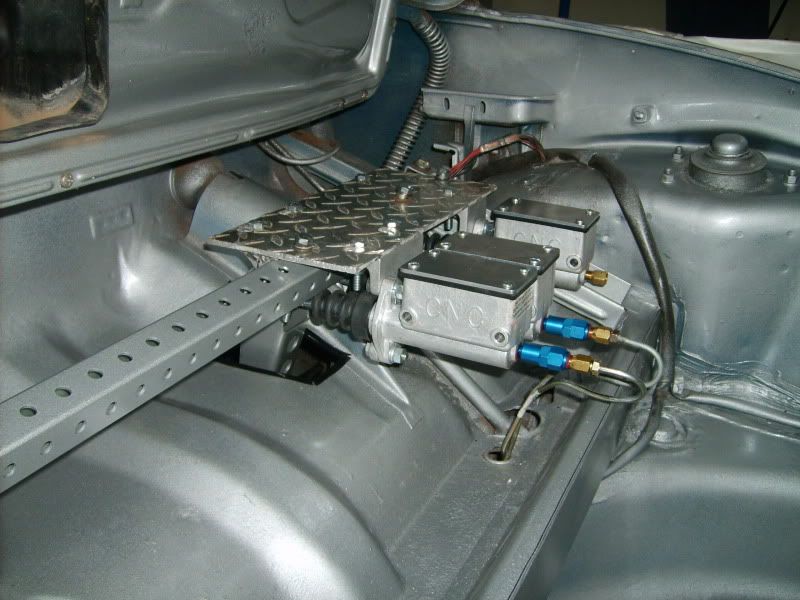
Not sure of your bleeding method, but what I recommend:
Do the two-person method of bleeding, even race teams do this. Fill up with brake fluid, have one person starting out a the right rear wheel, one person in the drivers' seat. String up a bleeder line off the valve that is elevated above the valve so nothing but fluid could be sucked back in. Pump the pedal a few times and HOLD medium pedal pressure on the last pump, have the person at the wheel crack the bleeder valve and don't let the pedal go all the way to the floor. Repeat a few times then go to the next wheel. Now, very important, after you've done all four wheels check how stiff the pedal is and do all four again one more quick time--I've found there is sometimes air still in there that gets pushed from one side to the other through the 'T'. The whole process takes about 20 min. Finish and go drink a cool one.
Never had any luck with those pumps or one-way bleeder valves or bench bleeding or whatever.
Re: brake efficiency problem
Posted: Sat Jun 06, 2015 7:52 pm
by FJCamper
Gentlemen,
The master cylinder should always be level with the brake calipers or slave cylinders.
Brake fluid, being liquid, seeks its own level, and with a master cylinder arrangement way above the calipers, there will be air in the lines.
Specifically, with the arrangement overhead as shown, on braking the pressure is to the caliper, but on release of the pedal, the fluid tries to return (upward) to the master cylinder ... but can't, and a standing air pocket is created. You see this unlevel situation on poorly constructed kit car and shade tree specials from time to time.
Even with a good bleeding, the air pockets will be slowly recreated.
You have to keep it all level.
FJC
Re: brake efficiency problem
Posted: Sat Jun 06, 2015 10:45 pm
by Ol'fogasaurus
When dealing with Off-roading it is not uncommon for the slave cylinders (caliper/wheel cylinder) to sit higher than the floor mounted MC; e.g., tall tires for example. If there are turning brakes involved and they are mounted on the tunnel then you might put a residual pressure valve against the MC to stop the bleed back from the turning brake assy.
Yes, the residual pressure valves are there to keep the shoes/pucks close to the drums/rotors the reason being to keep the brake fluid from seeping back into the MC which allows the shoes and pucks to back away from their duty position.
It is not uncommon for Bajas or even glass buggies to be converted to swing pedals (MC mounted up high) and use a bell-crank setup with rear facing MCs to stay inside of the body.
I can post some pictures of one if you would like.
Lee
Re: brake efficiency problem
Posted: Sun Jun 07, 2015 3:04 pm
by FJCamper
Hi Lee,
Yes, I know some buggies use this uneven system.
What makes it work for them (when it does) is the error tolerance of a closed high-pressure system (600 to 1500 psi) with an overhead fluid reservoir above the brake system.
Buggies are VW's twilight zone. You can find almost any kind of part and configuration on them. Because of this, buggy people are more tolerant of quirks, as their expectations are very different from street car or road racing owners.
I used to try and help buggy guys sort out their vehicles for autocross and we would always hit the impasse. If you civilize a buggy, it's not a good buggy anymore!
FJC
Re: brake efficiency problem
Posted: Sun Jun 07, 2015 3:46 pm
by Ol'fogasaurus

Maybe!

Now that you brought it up you just might be right... with closer introspection I do think we are closer to the origional hot rodders in as much as we put ("hash" in some circumstances) things together that don't belong together; masssage them to make them work as a unit.... which is the old hot rod idea. Road racers, by concept, are just another style of hot rodders too.
Modern day cars do use swing/hanging pedals as they allow the seats to sit lower in the car (like rails and many buggies do in order to sit within the confines of the body) and retain leg to pedal geometry rather then having to point your toes to brakie as with floor mounted pedals (I still have mine), shift or work the throttle.
I do agree with the civilizing of a buggy... it can become boring if it is too civilized but.... naaaah, it can't be done sucessfully and still have a fun ride.

Ever see a. "civilized car" try to run in deep, soft sand, climb an unmanicured hill of much more than 6% or tour the deep rock strewn desert w/o a film crew and back up support to dig the car out every so often.

Gosh, I never realized how much farm tractors are hot rods (foot operated turning brakes).
No offence meant

Lee
Re: brake efficiency problem
Posted: Mon Jun 08, 2015 12:55 pm
by jhoefer
FJCamper wrote:Gentlemen,
The master cylinder should always be level with the brake calipers or slave cylinders.
Brake fluid, being liquid, seeks its own level, and with a master cylinder arrangement way above the calipers, there will be air in the lines.
Specifically, with the arrangement overhead as shown, on braking the pressure is to the caliper, but on release of the pedal, the fluid tries to return (upward) to the master cylinder ... but can't, and a standing air pocket is created. You see this unlevel situation on poorly constructed kit car and shade tree specials from time to time.
Even with a good bleeding, the air pockets will be slowly recreated.
You have to keep it all level.
FJC
The master cylinder does not need to be at the same height as the calipers, on the vast majority of cars it is mounted higher than the calipers. It's really the location of the reservoir that matters. The reservoir needs to be the high point in the system, so as you say the fluid level stays above the calipers and MC ports, the fluid "level" being the fluid surface as it sits in the reservoir. If the reservoir is mounted low, then in certain situations, say when parked on a hill, the caliper could wind up above the reservoir and allow fluid to drain out of the calipers which then would introduce air pockets. Low mounted MC's and reservoirs are a source of problems, not a solution to them.
If the system is bled, and there are no leaks, you can't get air in the system as long as the fluid level in the reservoir stays the high point of the system. The MC pushes fluid through the lines in one direction, the caliper/slave pistons push the fluid back in the opposite direction. It's a hydraulic system, if the fluid couldn't flow back through the master cylinder, as you claim, the brakes would lock up. The only way to get air into this well bled and leak-free system is if you get excess water in the fluid and it turns to steam from the hot brakes.
Re: brake efficiency problem
Posted: Mon Jun 08, 2015 1:34 pm
by Ol'fogasaurus
Mr. H.: pretty much spot on but I think there are a couple of ("you undetstood". I got real excited when my english teacher back in the dark ages explained the concept of/about the "you understood" sentences) conversations going on here: a probably specific question and allied/over all question.
You talked about the reservoir sitting higher than the calipers which is what VW (et al) tried to do with the remote res. Personally, I think they caused more problems than they solved especially as they aged.
As I noted there are some of us that interject additional braking components into the system which also throws a monkey wrench into the braking system.
At this time we also throw pressure relief valves and bias or adjustable bias valves into the discussion. Things really are complicated aren't they.
Thanks for the good explanation though.
Lee
Re: brake efficiency problem
Posted: Mon Jun 08, 2015 2:08 pm
by Ol'fogasaurus
Re: brake efficiency problem
Posted: Mon Jun 08, 2015 5:50 pm
by jhoefer
Ol'fogasaurus wrote:You talked about the reservoir sitting higher than the calipers which is what VW (et al) tried to do with the remote res. Personally, I think they caused more problems than they solved especially as they aged.
As I noted there are some of us that interject additional braking components into the system which also throws a monkey wrench into the braking system.
At this time we also throw pressure relief valves and bias or adjustable bias valves into the discussion. Things really are complicated aren't they.
I agree that remote reservoirs add additional failure points as they deteriorate, but assuming you're stuck with the stock low-mount MC layout, I'd rather have problems years down the road that I could fix with replacement parts vs potential problems from day one from a directly attached low-mount reservoir. It makes sense for VW to have done this on a mass-produced vehicle that needed to be reliable with their low-mount MC (a different brake pedal layout would have necessitated a more complicated and expensive clutch pedal system).
It is a complicated subject in many ways and when modifying things, you typically have to take what you can get. You could design a perfectly matched braking system for your car, but that doesn't do you much good when you have to choose from off-the-shelf components, hence the compromises and workarounds that lead to other issues.
Re: brake efficiency problem
Posted: Mon Jun 08, 2015 9:52 pm
by FJCamper
Gentlemen,
The point is the location of the m/c either eliminates or invites complications. Residual valves fix these problems. Here's a very lucid quote from Hot Rods USA;
"Residual valves are pressure valves used to retain pressure in the lines. The most common use is on a hot rod when there is a floor mounted brake pedal and master cylinder. Mounting the master cylinder (M/C) below the floor positions it below the calipers. Gravity will cause the fluid to flow away from the calipers. The residual valve will retain pressure within the lines. (i.e. 2 pounds residual valve will retain 2 pounds of pressure, 10 pound will retain 10 pounds.) Drum brake master cylinders have residual valve(s) built into the master cylinder. This is needed to maintain pressure against the cup seals in the wheel cylinders. If you are using a disc brake master cylinder or after market you will need to install a 10 pound residual valve for the drum brakes. Do not install a residual valve if your master cylinder already has one in it. This will cause the brakes to lock up after the second application to the brake pedal."
A level system prevents trouble. Other configurations work, but need fixes (such as the residual valves) to make them work.
FJC
Re: brake efficiency problem
Posted: Tue Jun 09, 2015 10:47 am
by jhoefer
FJCamper wrote:A level system
To quote Inigo Montoya, "You keep using that word. I do not think it means what you think it means."
Re: brake efficiency problem
Posted: Tue Jun 09, 2015 1:17 pm
by FJCamper
Brake calipers or slave cylinders and master cylinder all on the same plane?
Ergo, level. a la VW Type 1.
FJC


