Page 4 of 5
Re: Lowering For Handling
Posted: Fri Apr 06, 2012 12:27 pm
by Chris V
Marc wrote:Look at the picture Chris posted of our `69 and visualize a line extending through the balljoint centers to the pavement - it's easy to see that it intersects the ground a couple of inches inboard of the tire tread centerline => positive scrub radius...great "feedback", but the wheel will be knocked out of your hands if a tire hits a big bump when you aren't prepared. Increases the steering effort at very low speeds, too...
Here's a better shot:
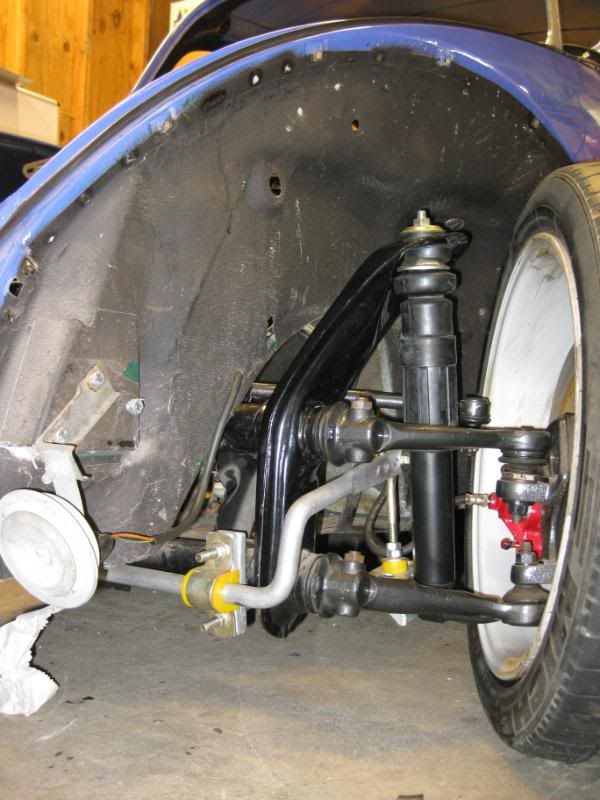
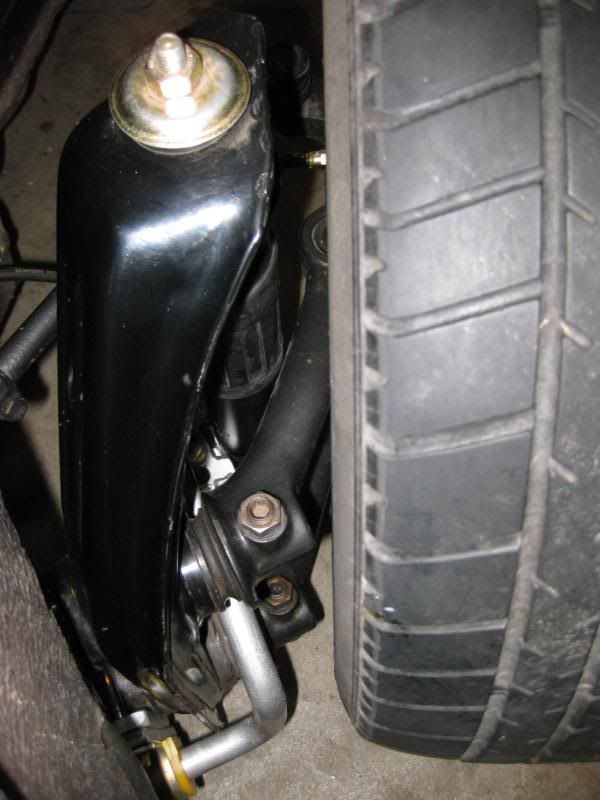
On a Beetle with a wide tire the scrub is always going to be a compromise of providing an acceptable feel and an acceptable turning radius...as the tire is quick to foul on the control arms/sway bars/body work/fender/shock tower. On our `69 I removed sections from the shock towers to gain room at full-lock and re-welded them.
Re: Lowering For Handling
Posted: Fri Apr 06, 2012 2:48 pm
by GS guy
In general, at least in my limited design experience, it seems difficult to get minimum scrub anyway with any kind of tire width. The suspension must be carefully design from a clean sheet to get it, and then with one specific wheel and tire size. Sure, you can use a highly positive offset wheel and get the scrub down, but then you can't turn because it hits something!
I think the best one can do is to try and minimize scrub with an existing design. Don't go too wide on the wheel and tire and take care planning your offset. This means you're into more specialized wheels and maybe custom spacers for highly + offset wheels.
Re: Lowering For Handling
Posted: Fri Apr 06, 2012 8:14 pm
by Marc
I've driven the `69 that Chris built for two days now, and can report that even with the amount of positive scrub present there's no great drama. Since he used a stock-diameter steering wheel (in deference to my bad shoulder which leaves me with only one good arm to steer with) neither the steering effort at low speeds or the feedback when encountering a a bump is objectionable. Super Beetles will always need the minimum achievable scrub radius to avoid the "shimmies", but a tight Standard front end can tolerate several inches of positive scrub before it's hard to live with.
Re: Lowering For Handling
Posted: Tue Jun 26, 2012 2:24 pm
by JWP
FJCamper,
What do you think the benefits if any would be from this kit to raise the engine and trans 1" thus lowering the body?
http://vwparts.aircooled.net/RLR-1-Tran ... 00-101.htm
Re: Lowering For Handling
Posted: Tue Jun 26, 2012 8:45 pm
by FJCamper
Hi JWP,
The Ron Lumus kit is really for drag racing, but raising the transaxle (to lower the body) has been done on road-race 356 Porsches to good effect.
FJC
Re: Lowering For Handling
Posted: Thu Apr 09, 2020 9:22 pm
by SparksLP
FJC,
Referring to your comment about the rear being no lower than "straight out", does that apply to both swing axle and IRS? Is there an optimal angle for a lowered swing axle?
Re: Lowering For Handling
Posted: Fri May 08, 2020 8:43 am
by eskamobob1
I have been trying to word this well for over 30 minutes and just cant, so I appoligize if it's a bit convoluded.
Assuming you have set wheel/tire combo, camber, and the trailing arms are shaped however they need to be for the set up, the scrub radius is purely determined by the shape of the spindle and how it mounts to those trailing arms?
Maybe a better way to put it. If you have an already built system and want to adjust the scrub radius for a new wheel/tire combo, the spindle must be changed to achieve this without affecting camber?
Re: Lowering For Handling
Posted: Fri May 08, 2020 11:31 am
by Ol'fogasaurus
Re: Lowering For Handling
Posted: Fri May 08, 2020 1:20 pm
by GS guy
SR is purely defined by trailing arm to spindle joint "centers", as-mounted wheel/tire centerline and tire diameter - in front view. Camber has a small effect, at least in a BJ spindle, as the upper BJ center is moved relative to spindle and wheel CL (slightly) during adjustment, changing the steering axis inclination (SAI) angle. SR is much more largely affected by wheel backspacing and some extent by overall tire diameter.
Eskamobob1 - to change scrub, yes and yes. You have to change the spindle design and/or wheel offset tire diameter.
Jeff
Re: Lowering For Handling
Posted: Fri May 08, 2020 2:03 pm
by Ol'fogasaurus
Then you might have to work with the angle the beam is mounted to the pan head also.
Re: Lowering For Handling
Posted: Sun May 10, 2020 7:12 am
by eskamobob1
GS guy wrote: ↑Fri May 08, 2020 1:20 pm
SR is purely defined by trailing arm to spindle joint "centers", as-mounted wheel/tire centerline and tire diameter - in front view. Camber has a small effect, at least in a BJ spindle, as the upper BJ center is moved relative to spindle and wheel CL (slightly) during adjustment, changing the steering axis inclination (SAI) angle. SR is much more largely affected by wheel backspacing and some extent by overall tire diameter.
Eskamobob1 - to change scrub, yes and yes. You have to change the spindle design and/or wheel offset tire diameter.
Jeff
Got it. Ty. I was basically just trying to confirm that if you built a ground up suspension you had to design the spindle based on your desired tire size/offset
Re: Lowering For Handling
Posted: Sun May 10, 2020 7:30 am
by GS guy
I think it's the other way - you base a ground up suspension design on desired characteristics of the spindle - SAI (KPI), ball joint locations relative to spindle axis, ackerman of steering arm, brake sizing, which is interrelated with your suspension design (roll center, camber gain, caster; "then" design/choose a wheel that provides the desired scrub, diameter, tire availability. Probably some back and forth - tweak suspension based on suspension design tool output, tweak the wheel dimensions, re-tweak suspension, etc.
Us mere mortals who don't want to drop a cool $1500 or more per custom wheel are stuck with what we can afford or is mass produced!
Jeff
Re: Lowering For Handling
Posted: Sun May 10, 2020 10:13 am
by Ol'fogasaurus
I pretty much agree with Jeff. Looks are one thing safety is usually another. There are things that took many, many years to correct the design of but people are still using them due mostly to lack of knowledge and... it's really cool dude! On the build shows on TV I am starting to seem some aftermarket correction being put into place.
I am old enough to remember when "reversed" rims first came onto the scene and there were a lot of "Aw $#its" caused by them alone vs. other changes that sometimes worked and other times didn't. The geometry as a whole does have to be paid attention to; e.g., the combination of all components.
Lee
Re: Lowering For Handling
Posted: Tue Oct 13, 2020 9:00 pm
by eskamobob1
Anyone know roughly the stock scrub radius of a BJ beetle?
Also, @FJ. You mention keeping the rear slightly power than the front. Does this apply as much to IRS beetles as it does to SA? I would assume not (and unequal heights front and rear is predominantly used to tune weight transfer with IRS), but is that correct? What kind of lowering did yall run on your SB?
Re: Lowering For Handling
Posted: Wed Oct 14, 2020 9:44 am
by FJCamper
IRS axles need to ride "straight" (meaning parallel to the road) for the best handling, whereas swing axles do not. Typically they have some upwards slant towards the wheel to get negatives camber.
We find that a two-inch lowering front and rear (regardless of suspension type) greatly improves handling, and still allows enough ground clearance to handle ramps, bumps, allow jack access, etc.
A refinement is allowing the rear to be 1/2 inch lower than the front on swing axles. This counteracts rear suspension "jacking" where the rear of the car tries to rise based on hard accelleration or hard braking. You'd think hard accelleration would make the rear end squat, and it does, but not before all the forces from the axles hits the tires and for a short time, the rear end elevates. That can be enough to lift the transaxle and force the car into positive camber just long enough to make one of the rear tires outer edges self-steer.
Hard braking does the same thing. Nose down tail up.
Our Blitzwagen Super Beetle has adjustable spring plates in the rear and coilovers in the front. We lower the Ghia with low profile tires. No geometry changes to worry about.
FJC