
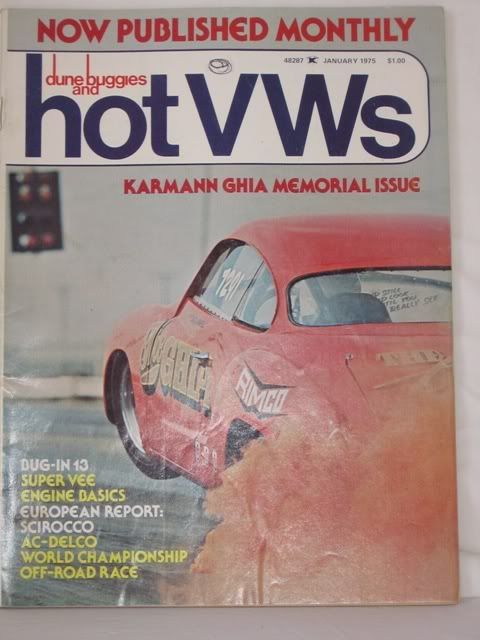
Above: The January 1975 Hot VW Karmann Ghia Memorial Issue
I wrote the feature for Hot VW's for this special edition. It was published in HOT VWs (Jan 1975) and their Vintage Special in July 1985
THE KARMANN GHIA FROM BEGINNING TO END
by Frank Camper
If you own a Karmann Ghia, a feature story in the June '72 Car & Driver just might interested you. Car & Driver pitted a street stock 1972 Ghia against - of all things, a Porsche Speedster.
The Speedster comes to mind for car aficionados as one of the classic performance automobiles - especially in the minds of Porsche fans. The Ghia bested the Porsche. The purists were aghast, of course. But the fact remained, the late model Ghia was a better car.
This news fell on deaf ears, however. The sports car clique was not ready to accept a VW into its fold.
Then Road & Track added fuel to the controversy in April of '73.
The Karmann Ghia was included in a test of "showroom stock" sports cars for the SCCA's newly formed racing class. The Ghia, in the skidpad handling test, finished in the middle of the field of cars, and lapped Riverside Raceway only 3.2 seconds slower than the Porsche 914.
What was happening? Was Volkswagen finally building the Ghia as a "real" sports car?
No. Even as the test Ghia was being thrown around Riverside, Volkswagen had marked the Ghia for extinction. 1975 saw the last Karmann Ghia leave Osnabruck as after 20 years of production, VW called it quits.
The idea to build the Karmann Ghia did not originate at Volkswagen.
The concept came from the Karmann Ghia Coachworks of Osnabruck, Germany. Wilhelm Karmann took over the coach building firm of Klases in 1901, and renamed it after himself.
The first automobile body was built at Karmann GMBH in 1902, and a few years later, production was converted entirely to autos. Prior to the First World War, Karmann employed approximately 50 people and provided bodies for the firms of Opel, Minerva and F.N. Bodies were built on chassis supplied by those concerns.
The war interrupted the growth of the company, but Wilhelm Karmann, with a group of German auto manufacturers, traveled to the United States in 1924 to study modern production methods and improve the old-fashioned techniques practiced in their homeland.
Karmann learned steel body work and spray painting in America. With this new technology, the Karmann firm began series production. The first order was for 1000 bodies from AGA. Others followed.
The success of the body building firm increased, until the business depression of the late '20s ruined most of Karmann's best customers, including Hansa-Varel, Hansa-Lloyd, Mannesmann/Automobile Division, and Protos-Berlin.
A business relationship that Karmann entered into with the Adler factory in Frankfurt saved them from collapse. This relationship steadily increased until the outbreak of the Second World War.
One of the fruits of working with Adler, and a benefit to every Karmann Ghia convertible owner, was the development of Karmann's expertise with convertible top manufacturing. The Adler convertibles took many firsts in Concours d' Elegance with the weatherproof, trouble-free Karmann roofs.
At the outbreak of WWII, Karmann employed 600 people producing 65 units a day. The war brought terrible destruction to the Karmann factory. The British army occupied the standing buildings and forbade any work. All activity was at the order of the British, for repair and maintenance only.
Reconstruction was slow, and starting again with only a handful of workers, Karmann GMBH supplied body sections and tools to Hanomag, Bussing, and notably, Ford. The postwar Ford Taunus was a product of the Karmann factory.
Volkswagen entered the Karmann picture for the first time in 1949. It was a contract for the original VW convertible that began the successful business between Karmann and Volkswagen.
By 1951 Karmann employed 1,300 people. The orders for parts and bodies poured in monthly, and Karmann was on the way up again. In 1952, Wilhelm Karmann died at the age of 82. His son, Wilhelm Karmann, Jr., took over management of the company.
Thousands of Ford, Porsche, VW, and BMW were being made at Karmann by now and the entire German automobile industry was supplied with tools and pressed steel parts by Karmann. However, all of the vehicles leaving Karmann belonged to someone else and the Karmann Works wanted an automobile to bear its own name.
The decision to use the VW chassis and components was made at Karmann after agreements with VW to market the Karmann automobile through the growing VW dealership network. The Karmann car was to be a sports car. Porsche was then demonstrating the feasibility of the rear engine concept in a sporting automobile.
But to be a success, the car had to look like a fast sports car. And it was here that Carrozzeria Ghia of Torino, Italy, became part of the story.
Ghia had begun, as had Karmann, a coach building factory. It was founded in 1915 by Giacinto Ghia, who was a highly-skilled coach builder. Ghia prospered right along, catering to the aristocracy of Europe until the Second World War. Bombers destroyed the Ghia carriage-works-turned-war-production-factory.
Ghia struggled on, building bicycles to exist. Giacinto Ghia died in 1946, his plant still in shambles and his company without business.
But the same will to survive that Karmann displayed was present at Ghia and the heirs of Giacinto Ghia selected Mario Boano to manage the ill but recuperating business. And it was Boano who hired the man that designed the Karmann Ghia - Luigi Segre.
Segre was an energetic and capable stylist and businessman. He appointed a staff of young stylists, designers and engineers that became a foundation for the future of Ghia.
Segre was approached by Karmann to design the firm's new automobile. The result of the Ghia studios is, of course, history. The 1974 Karmann Ghia very much resembles the first design shown to the press on June 14, 1955 at the introduction of the "Karmann Ghia Volkswagen."
The Karmann factory tooled up a production line beside the Porsche Cabriolets and VW convertibles, and by October of 1955, the Karmann Ghia was on sale to the public.
The acceptance of this appealing, modern little coupe was tremendous.
"Was it another Porsche?" the press asked. Volkswagen and Karmann stated the Karmann Ghia was not a "sports" car, but a "sporty car," designed for stylish and pleasant touring.
The car's lower center of gravity gave it more responsive handling than the Beetle, and better aerodynamics increased the top speed over the classic Volkswagen by almost 10 mph.
In 1956, the Karmann Ghia came to America in quantity. And even with a P.O.E. price of $2450, it sold. [a 1956 Chevy Belair convertible went for $2340, and a new MGA sports car at about $2600]
It sold so well VW dealers were back-ordering Ghias. The problem was, not enough of them could be obtained. However, there was not to be a flood of Ghias from the Karmann works. With all of its subtle curves and intricate lines, mass production of the Karmann Ghia was impractical. The body could not be stamped out fast and hastily assembled with the other components. Each body was hand-welded together, fitted with exacting templates and worked with and fussed over until over 200 inspectors had passed judgment over it.
The amount of hand labor involved in the creation of one Karmann Ghia was incredible. The fenders, the corners of the windshield, the curve around the headlights - all those sensual bits of styling were fitted, shaped and finished by men with hand tools. Men lovingly molded their media of metal with molten pewter and beechwood hammers so that the finished body did not reveal a seam or weld line anywhere. And just to be sure, sharp-eyed inspectors rubbed cotton-mittened hands over the rows of Ghias to detect any blemishes in the metal.
The final product, gleaming silver in naked metal, showing auras of heat discoloration in a hundred spots, next went to the painting process.
A complete submerging into anti-corrosive zinc phosphate was followed by a wet sanding and the initial coat of paint. Then the first coat was sanded out smooth and repainted. Again the painting and rubbing procedures were repeated until the fourth and final coat of paint was applied in a dust-free atmosphere created in a special booth where a falling curtain of water would draw out all excess dust and paint particles in the air.
The finished bodies were then fixed to chassis supplied by VW. The standard Volkswagen floor pan was not wide enough for the Karmann Ghia, so a special platform was built up. The combination of the wider floor pan and the structurally braced body resulted in a much stiffer base from which the suspension could work. This improved handling gave the car a more secure feeling than its ugly duckling cousin, the Beetle.
The actual suspension components themselves were only standard VW parts, and in 1956, that meant narrow brakes and wheels, hard rear torsion bars and flexible spring plates, plus a high-pivot swing axle in the rear and a kingpin front suspension.
With it all propelled by the 36bhp engine, the total effect was considerably less than you would hope to expect from a sports car.
VW and Karmann did make compensations, however. The Ghia chassis usually incorporated technical improvements first, and the front stabilizer bar developed at Porsche next found itself on the fledgling car from Osnabruck. It was used on regular Beetles a year later.
The jetting of Ghia carburetors was often different from Beetles, allowing for slightly better performance.
The first Karmann Ghia Cabriolet appeared on the market in 1956 ... one year after the introduction of the coupe. This first series of Cabriolets is, in fact, the most rare of all Karmann Ghias, as the first and only really significant styling change happened to the car in 1958. The facelift involved raising the fenders slightly, placing the headlamps in a higher position, widening the forward air intakes, and fitting a stronger bumper. It was the same bumper that remained on the Karmann Ghia until the federal safety bumper that finally came out on the 1972 Ghia.
A Cabriolet is a little fancier than a plain convertible. Most common convertibles have a simple roof which consists of a frame and some stretched fabric. A Cabriolet is what the Karmann factory provides lucky Ghia owners with, complete with a fully padded and lined roof and, just for good looks, a glass rear window.
Even at the best of times the production of the Ghia Cabriolet was very limited.
It has never exceeded 20% of total output. One of the reasons, of course, is the roof itself. It took two men working 4 1/2 hours to hand make just one. The precedent for the Karmann Ghia was the 356 Porsche sports car. The problems and solutions developing at Porsche influenced the future of the Ghia before the first Karmann Ghia rolled from the assembly line.
The streamlining of the Porsches had a very favorable effect on their performance. High cruising speeds and low fuel consumption were the direct payoff. The Ghia studios had taken that into consideration and aerodynamics were an integral part of the Karmann Ghia's shape.
Simple operating features were taken directly from the Porsche, like the engine compartment lid release and torsion bar access ports. Later, the gas cap release mechanism with its protective rubber flap was added to the Ghia, adapted from the 356B series Porsche.
Sitting in a Karmann Ghia and a 356, almost all controls share exactly the same function with the identical position relationship to the driver.
The functional, flat-faced dash with its narrow padded top was very similar in both cars.
Ghia mimicked the Porsche with a 3-gauge dash, but the Ghia lacked the predominant tachometer which was the principal instrument in the 356.
But as alike as the two automobiles were, there was still a world of difference.
The Porsche was made to run fast and handle while doing it. The Karmann Ghia was not.
The Ghia was a sports car with the performance left out. The Porsche, however, was having a most beneficial effect on the Karmann Ghia. It was a proving ground for advancements.
Each suspension and brake discovery at Porsche filtered its way into VWs, The Karmann Ghia profited from the improvements more than Beetles, of course, because of its shape and height. But perhaps more attention was lavished on the Porsche engine than any other single item.
Where the VW engine was restricted for long life and economy, the Porsche was constantly being opened up one way or another for increased performance. From Porsche, VW learned how to handle higher and higher rpm, how to cool itself efficiently, what exotic alloys afford strength and lightness, and just where the limits of economy, reliability and performance met. So it was over the years that with one addition at a time, one improvement after another, the Karmann Ghia took on the Porsche components.
But in 1957 the sports car set did not see it that way. The KG was a Volkswagen, and the farthest thing from a sports car was a VW.
Only one tiny portion of the market "discovered" the Ghia - the knowledgeable VW buyer. Usually admiring the Porsches, but unable to afford one, the VW owner would swap to a Ghia instead. And even that wasn't cheap.
The average going rate for a new Porsche then was $4000, and the Ghia cost nearly $2500. A lot of 1957 dollars. Remember that a Beetle cost less than $1300 at that time.
So the Ghia buyer had to be willing to pay double for the privilege of pushing a 1200cc VW around.
A Beetle driver's first turn at the wheel of a Karmann Ghia was usually an eye-opener.
The closeness to the road, the seating posture, the position of the controls and the increased feel of command over the car were so different from what they were accustomed, and it just "didn't feel like a VW." The only VW clue was the exhaust note from the air-cooled engine thrashing away in the rear. That was the same.
The 1950's wound out and the popularity of the Karmann Ghia increased, with sales climbing every year, totally without the help of national advertising. It was six years after the introduction of the car that the Ghia had its first ad.
Doyle, Dane, Bernbach, the agency that took as honest and amusing approach to VW advertising as VW had to the automobile industry, chose 1961 as the year of disclosure for the Karmann Ghia.
With photographs of the Ghia from all sides, the headline ran "This ad is six years late." The body copy made it clear that the sports car that had been mistaken for everything from an Alfa Romeo to a Ferrari was - brace yourself - a Volkswagen.
So, it wasn't secret anymore. But the mass of the motoring public still didn't catch on, and the Karmann Ghia to this day is still confused with faster, more exotic machines. With the Karmann factory putting out to capacity, 120 KGs a day was maximum. This meant in a good year, only 40,000 cars could be produced.
The bulk of the automobiles went to the United States, with just over 20% reserved for the European market.
But the Europeans were treated to a special model from Karmann, a car not available for sale in the USA. Accustomed to more sophisticated and faster cars on the continent, Europeans received a new KG in 1961.
This was the Type 343 model, built on the VW Type 3 chassis instead of the usual Type 141 Ghia on the Type 1 chassis.
Americans were making do with a 1200cc 40-horse powerplant in '61. The Type 343 Ghia boasted a 1500cc engine and dual carburation.
The styling was radically different from the Type 1 Ghia, and the price just over $3000. Performance was equal to a 356 Porsche Normal, and the 343 was outfitted for European tastes.
There were reclining seats, built-in fog lamps, push-button controls for nearly every electrical item in the car, and it was the only VW to ever have an electric sunroof.
The styling of the 343 was considered a modification to the Type 1 Ghia and in 1962 a prototype was built using variations of both cars features. However, it never got into production.
The 343 was known as the "1500" Karmann Ghia in sales literature. The 1600 model was introduced in 1966. In America, the 1500 engine was not to see use in the Ghia until 1967, followed by the 1600 in 1970.
In 1969, the 343 Ghia took one last distinction. It was the first VW to be dropped from the model line.
Today you can see occasional 343's, brought into the U.S. by military personnel or down from Canada where the cars could be ordered from Germany.
In the early '60s, while the 343's were running up and down the autobahns racing with everything under 2-liters, the VW owners in the U.S. were flogging their 1200cc beasts, trying to maintain 70mph on the open road, unaware of what was in store from VW.
The 1300cc engine emerged in 1966, the only year of its usage in a US VW product, and was a harbinger of greater things to come. The 1300 represented a 10bhp increase over the 1200cc, and new U.S. Ghia owners in that year had a bit more zip to play with.
While the European market enjoyed one style of Ghia and North America another, the South American Karmann Ghia was yet another version. VW of Brazil received disassembled VWs from the German factories and built them on South American soil.
The Karmann Ghia was one of the models available to the Brazilians - but with a major difference. The creative urge of many VW departments found its outlet in the South American market. Personnel desiring to try new ideas and upgrade the VW image discovered that Brazil was a haven for them.
The VW leadership was more innovative in Brazil, not like the regimented German concerns or the strictly American low-base-line consumer VW thinking. Brazil gave birth to the TC Karmann Ghia, a fastback design with a rear hatch, built from the basic Type 1 Ghia.
There was more room in the rear seat, larger window area and big pop-out back vent windows. The famous SP1 and SP2 sports cars were Brazilian, built at Karmann do Brazil, the South American affiliation of Karmann of Germany.
The SP1 and SP2 models are often thought of as the "Brazilian Karmann Ghias." They are actually Type 4 chassis, available with either the 1600cc pancake engine or the regular 1200cc Type 4 VW-Porsche powerplant, and a highly styled coupe body. They are beautiful automobiles, and are built by VW, but they are not true Karmann Ghias.
The turning point for the Karmann Ghia in the U.S. was 1967. That was the year it came of age as a performing automobile. The 1966 Ghias had represented the last of the old line of VW mechanical technology.
In 1967 progress struck and the Ghia came out on top. Front wheel disc brakes appeared and the old 6V electrical system became 12V. Front and rear braking circuits were now separate for safety and you got seat belts in the bargain. The 1500 engine was now a reality in the U.S., and a factory camber compensator of a very sophisticated design kept it all on the ground for the rear swing axle suspension.
The Ghia could now stop, go and turn corners in a truly fun manner.
A good '67 Ghia is a classic in its own right. The rear track was widened 1.7in. for better handling.
The old kingpin front suspension had bowed out in 1966 to ball joints, and the transmission final drive-ratio was changed to make cruising more pleasant. Air conditioning was offered for the first time in 1967, and that year will be remembered as the era of the "Fake Teakwood Dash" by all the Ghia owners who deplored it.
The painted metal dash, so attractive in the 356 Porsches and earlier Ghias, somehow got covered with wood grain contact paper. Karmann did a masterful job of fitting it in, but it won the Ghia few friends.
It was too nice a car for fake touches.
In 1968 came smog and safety equipment, by Federal decree. Horsepower took a beating from emission controls, operating temperatures went up and engine life went down. But 1968 was important. A major change was available on some VWs, offered with the optional Automatic Stick Shift.
A multi-jointed rear suspension replaced the swing axle that had dated back to the original VW prototypes in the '30s.
In 1963 Porsche had developed the 4-joint rear suspension for its new 901 series automobiles. Camber changes in suspension deflections were minimal and handling was greatly improved.
The addition of the 4-joint rear suspension to the Karmann Ghia changed the entire nature of the car. The geometry was so different the feel of the car was altered even traveling in a straight line.
The potential for a potent handler was present in the Ghia with the elimination of the swing axles. In, 1969, VW featured the 4-joint as standard on all models.
And 1969 brought another asset to the Karmann Ghia. A famous American designer, W. Dorwin Teague, selected a Karmann Ghia for his list of the world's most beautifully designed products. This was public acknowledgement of the highest order. Teague also named the Ericofon phone, a Kill collection chaise, a Bohn calculator and a Carlsberg beer bottle as his choice of the most visually appealing objects.
The announcement didn't make the Ghia any faster, but it did wonders for moral support.
The basis for the "new" 1600cc engine was ushered in 1970. The '70 engine displaced 1600cc, but without the engine accessories necessary to make it work well. A conventional single-port intake system, old style steel oil cooler and small carburetor prevented the new 1970 1600 from reaching its maximum. The new engine case was a result of VW studying the effects of emission controls on engine life, while a bigger oil pump, enlarged oil galleries, better metal alloy, dual oil pressure relief valves and a stronger "bottom end" vastly improved the VW engine.
A complete updating of the VW engine was seen in '71. New dual port heads, better valve metal, larger carburetor, bigger aluminum oil cooler relocated to improve cylinder cooling on numbers 3 and 4 - all resulted in a new, strong, reliable engine that sent VW enthusiasts into fits of excitement over the possibilities.
The requirements for a performing Karmann Ghia were completed in 1972. The front disc brakes were improved, a trip meter and a 125mph (up from 90mph) speedometer was added to the gauges, making the information to the driver now register time, speed, distance and fuel quantity.
It was this 1972 Karmann Ghia that beat the Porsche speedster in Car & Driver's test. With the 4-joint suspension, disc brakes, and dual port head engine, the Ghia was finally a contender on the sports car scene.
The '72 Ghia represented the high water mark of the Karmann Ghia, because by '72, the decision to cashier it had been made at VW. Things had been changing at Volkswagen, too, after all those years. New management, new ideas, new goals, and new problems signaled the end of VW as it had been. The company was heading into trouble.
Long the Research and Development arm of VW, Porsche AG was being phased out. NSU-Audi was on its way in with plans for front engine, front-wheel drive, water-cooled motor cars that would wear the VW nameplate.
Tighter U.S. emission control and safety legislation hemmed in old model designs. World-wide inflation cut into profits, and suddenly, the aluminum, air-cooled VW engine was too expensive to build, too hard to control emissions, and no longer as economical with fuel in its modified state.
Sales were off and falling, and VW moved to meet the future. The Type 411-412 luxury VWs, the Type 3 Squareback and Fastback, and the Karmann Ghia got the axe.
Production of the Beetle tapered off and today it is no longer built in the main VW plant at Wolfsburg.
The drastic changes were happening quietly though, and '73 and '74 Ghia production cars squeaked out, with prices soaring up on the cars. A '72 Ghia coupe cost $2700, up only a few hundred from its 1956 introductory price. But by '74 the coupe was ticketed at $3475 and the convertible a sizable $3935.
A terrific bargain in 1972, the Ghia was far overpriced in '74.
1974 was the last year of Karmann Ghia production. The '73 Ghias received alternators, floating caliper disc brakes and stronger
transmissions, but lost the folding back seat; '74 brought only small technical improvements in track width, alloy metals and safety equipment. Development had stopped.
Even the once profuse sales literature booklets extolling the virtues of the Karmann Ghia vanished, replaced by cheaper, one-fold handouts. Meanwhile, Volkswagen's "successor" to the Karmann Ghia was being run in 1973 at the VW Test Track. It was a modification of the basic Audi design, a front-engine, water-cooled, front-wheel drive automobile named the Scirocco.
(Scirocco means desert wind. Read that as "hot air.")
the end


 ) I really enjoyed the post thanks FJC!