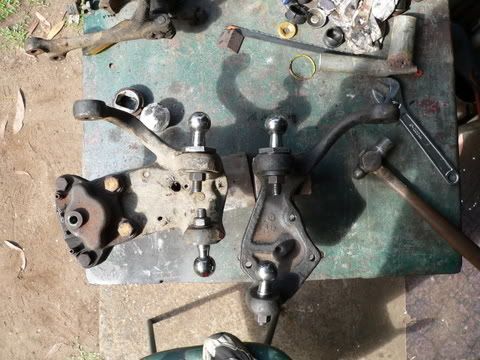
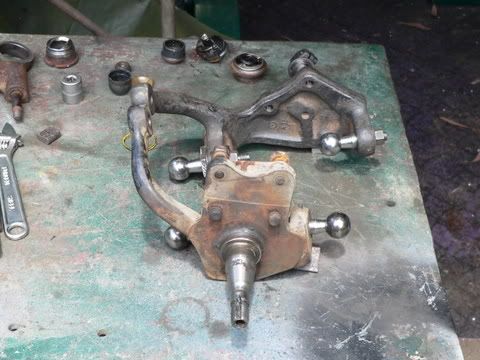
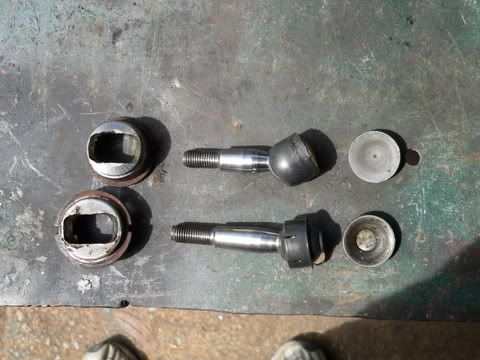
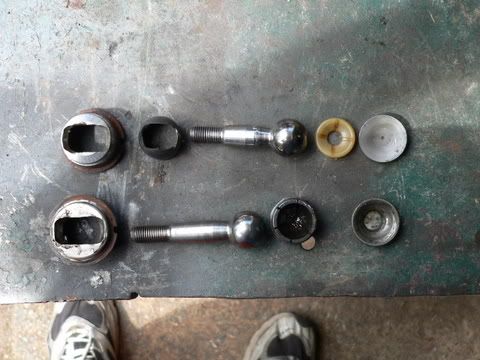
how are they made?
this could sound like a some stupid stuff but would it be possible to get a spindle (the nobby bit on the end?) and weld it to the plate?, then weld the bars on the outside?
I wish they did drop/raised spindles for T3s...
Right now the only option is ~$1K US from a fellow in Europe.
I'd happily do $325 for a ~2" drop w/o losing everything else.
Addendum to Newtons first law:
zero vehicles on jackstands, square gets a fresh 090 and 1911, cabby gets a blower.
EZ3.6 Vanagon after that.(mounted, needs everything finished) then Creamsicle.
kyle_pc_75 wrote: if only they made the arms to go with them!
Kyle
I have read that you can take the stock lower type 1 trailing arms and swap them left to right and right to left so the ball joint studs point down and they will fit Thing spindles.
They show making them in standard hight or 1"-3" lift. I thought Thing spindles were already 3" higher than type 1 spindles so is this 3" higher than a standard type1 or a standard Thing (that would be a 6" lift)
I have a set of Thing spindles and arms on a shelf, I will have to compare the two.
Two Wrongs Don't Make A Right...... But Three Lefts Do!
I am going though this now myself and this is what I think I have learned:
I think the spuds on the Thing (type 181) spindles are located about 2.5 inches lower on the spindle than are the stock bug spuds which raised the vehicle. Lower Thing trailing arms load the ball-joint from underneath as compared to pressing the lower ball joint on a bug which loads from the top. The shaft on both the lower and upper Thing ball-joint is slightly larger in diameter that the bug ball-joints. The eccentric on a Thing upper ball-joint is slightly larger in the inner hole diameter than the bug unit is and that is because of the diameter of the Thing upper ball-joint’s shaft. So far; I think the bug upper ball-joint, which also means the eccentric which is easier to obtain now days, can be used on the thing upper trailing arms. I am not sure if the lower bug ball-joint, because of the direction it is designed to be pressed in, can be used. I am under the impression that the main part of the ball-joints, the part that is pressed into the trailing arms, on both the bug and thing, are/maybe the same.
I have not heard of swapping trailing arms from side to side before so I can't speak to that.
I hope this helps.
Edited for some spelling and clarification reasons.
Last edited by Ol'fogasaurus on Mon Feb 14, 2011 10:08 pm, edited 2 times in total.
Steve Arndt wrote:Unless I'm mistaken, Tweed lifted spindles use normal T1 arms and balljoints. They don't have the bottom B/J flipped like a thing does.
That's what I thought at first, but these are new and different from their regular lifted b/j spindles. Look at the spacing of the spuds (thanks for the word of the day, 'fog), they're clearly for the Thing arms.
Steve Arndt wrote:Unless I'm mistaken, Tweed lifted spindles use normal T1 arms and balljoints. They don't have the bottom B/J flipped like a thing does.
That's what I thought at first, but these are new and different from their regular lifted b/j spindles. Look at the spacing of the spuds (thanks for the word of the day, 'fog), they're clearly for the Thing arms.
Kyle
Well Ching Ga Ling! Maybe they will market some 1x2 "thing" arms to match. Or why not make them use bus b/joints top and bottom?
Steve; that is my question also. I am still in the; I think I know stage on this so be advised on that. Tonight I had a short talk with another guy who is into Things and has some Thing stuff (he just disposed of a lot of stuff and he thought that some Thing eccentrics were in the lot... shazam!), but I had to cut it short as he just had open heart surgery and was still at the light duty stage (I have head open heart surgery too so I was conscious of this and got off the phone quickly). In two weeks I have an appointment with him to get some more information.
Tomorrow, I will go out and see if the stock sedan lower ball-joint fits (which I think it does) the Thing spindle but as Lorat says there may be some travel restrictions in the sedan BJ as compared to the Thing BJ; something else I am not sure about either.
If you are only interested in the lift then you can get the spindle or have BCR make you a set for a similar price. To me, it was the potential of the sedan lower BJ pulling on a hard bump but if you put hook and pin stops in, maybe that is enough protection, assuming that you don't care about the length of travel.
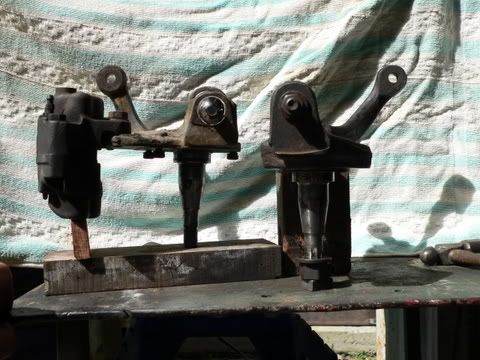
You can see the difference in offset of the spindles from the ball joint centrelines.
You can see how the centres of the balljoints are the same for the BJ and 181 spindles
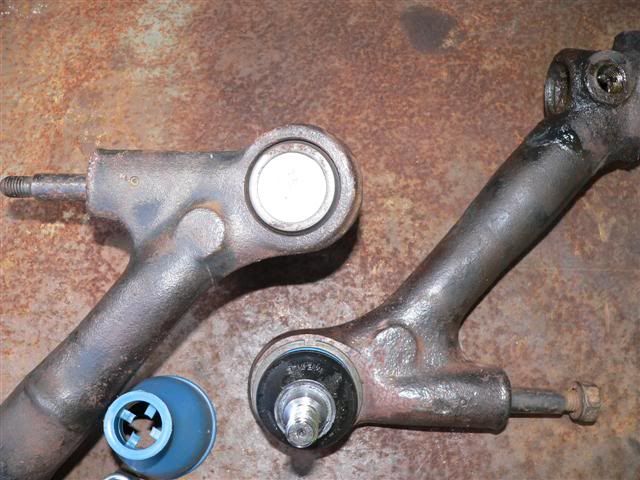
Standard ball joints, you can see the limited surface area that the lower ball joint(top one in this photo) has to work on.
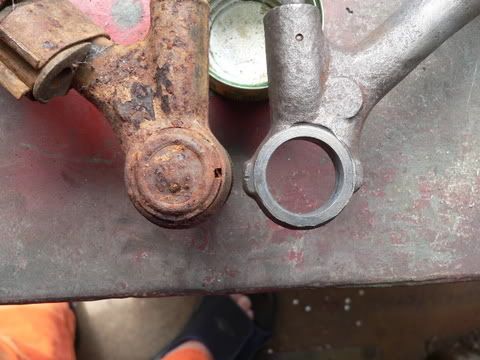
BJ and 181 lower trailing arms
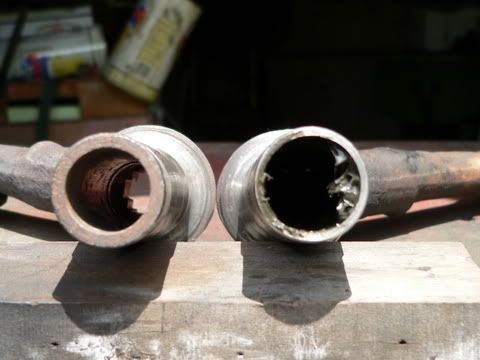
181 trailing arm has thicker wall thickness, upper BJ trailing arm has same thickness as lower 181 arms
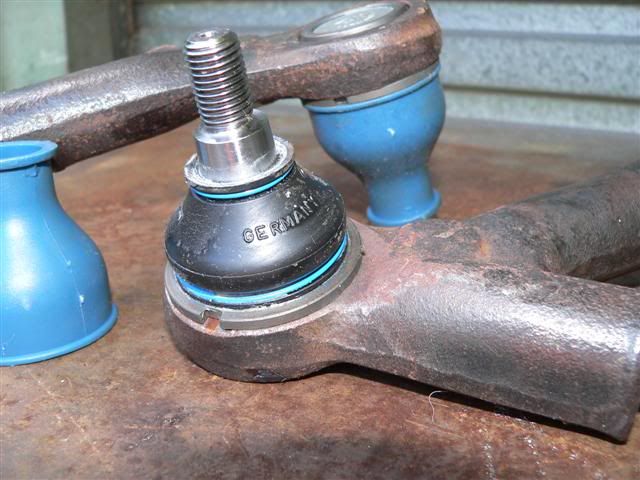
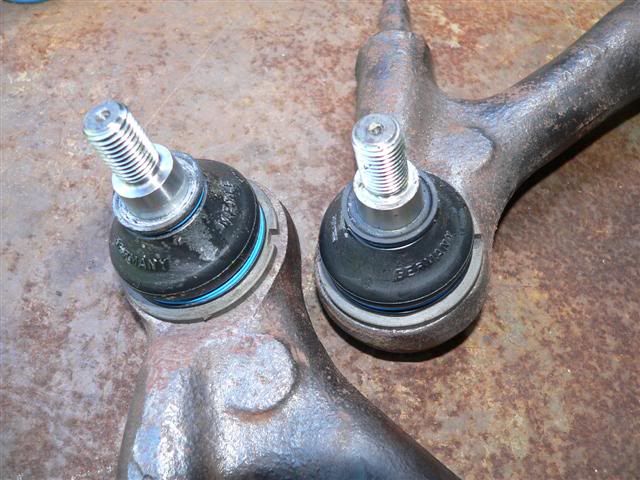
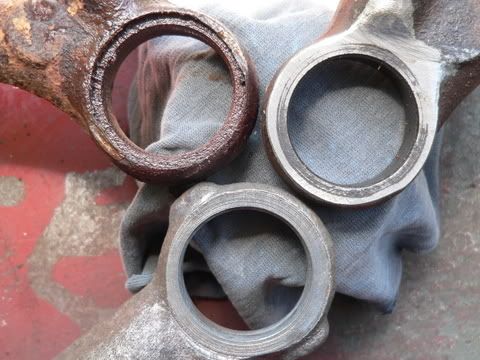
BJ, modified BJ and 181 ball joint socket in lower trailing arm.
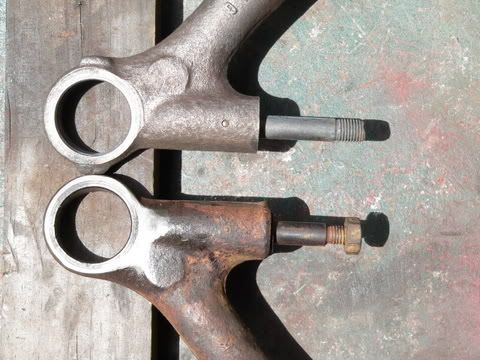
This shows the difference in the shock absorber mounts, but the axis and centre line of the shock absorber remain the same. The 181 stud is longer and the boss machined back closer to the ball joint to accommodate the longer sleeve on the 181 shocks. The 181 stud has a larger thread.
I can see no difference in the geometry of the 181 and standard ball joint trailing arms. I have easily modified a lower bj lower trailing arm to accept a 181 ball joint.
Here are standard balljoint lower trailing arms with the lip ground off and thing balljoints fitted. Part of the lift from standard thing spindles is in the balljoints.
Very nice info...thanks, guys. I have a couple sets of Thing and Beetle arms (front and rear), beams, spindles, and ball joints in my garage if there's any missing info here. I'll fill in what I can.