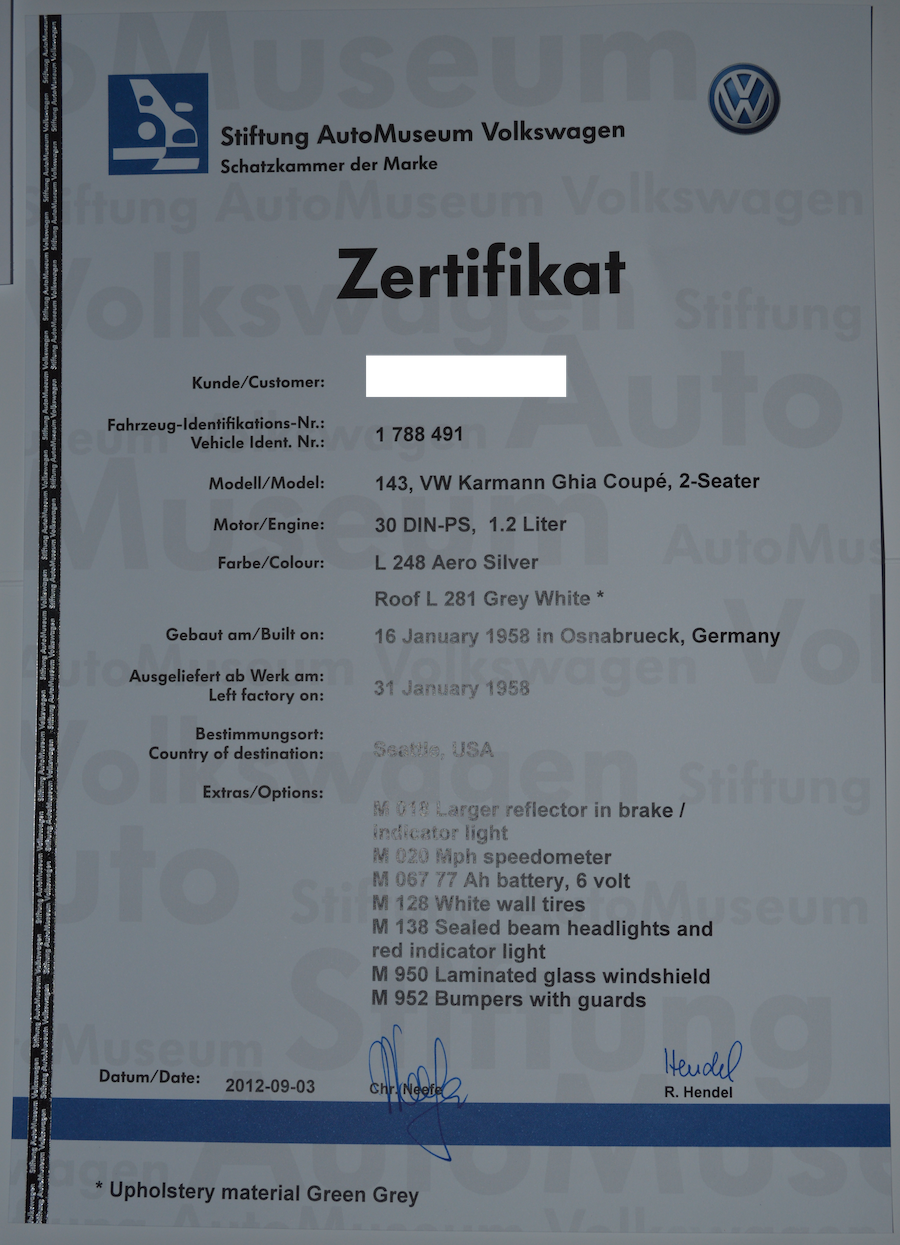
Marc wrote:I don't know of any way to confirm that the engine and transaxle are the exact ones it had when it left the factory. Even if you spent the money for a "birth certificate" for the car, those numbers would not be on it (example below). The good news is that as long as the numbers are appropriate for the production date of your car, nobody's going to be able to tell if it
isn't "numbers matching" either.
I believe, however, that the engine has been replaced. I've never seen an original 1965 engine with the "D" prefix
http://www.basilari.com/wp-content/uplo ... -small.png
That is what confused me too, I looked up the pan numbers and they seem to be correct but the engine number should start with a 3 or 4 based on the book I have. I the book I have: "U" is associated with type III engines; e.g., U (space) 0 000 001 in '68 and ending at U (space) 0 502 000 in '71. Starting at U (space) 5 000 001 and ending at U (space) 5 057000 in 72 (source the EMPI catalog for 2010).
Marc just did a short treatise on type III engines and the original question was a bit different but there might be some usable information here:
“... On Type I cases you can (usually) identify a case pretty well just by the prefix letter. Not so much on a III, you need the entire serial number to nail down the production date.
U means D-Jetronic 1600cc with a ~7.64:1 CR. The numbers started in `67 (for the `68 model year) with U0xxxxxx and ran through into the `73 production. There were other sequences, such as U5xxxxxx for the ~7.3:1 version or T0xxxxxx for dual-carbs (not offered in the US past the `67 model) as well.
Regardless of the ID letter/number, Type III cases were comparable to contemporary Type I cases when it came to oil passages & metallurgy. They lacked a dipstick tube or threaded hole for the oil pressure sender, and those fitted to cars with IRS rear suspension (starting with the `69 model year) all had special castings with bosses to allow the drilled/tapped holes for the rear engine hanger "moustache bar". `68-`71 IRS Bus cases also had these holes, and sometimes those case castings were diverted to Type I production but only the Thing used them (not for a hanger, but for a skid plate).
`68/`69 cases (H5 Beetle, B5 Bus, U0 III) were all single-relief, small-passage cases cast from the worst alloy ever used in any VW case, referred to as "cottage-cheese" because they crack/crumble/warp and suffer pulled threads worse than any other. These are junk, suitable for keeping the rain off of any potentially usable internal parts.
`70 (B6 or U0) had the larger passages and dual-relief temp/pressure control setup, and a better alloy. OK for a stocker, maybe.
`71 Bus & `71-`73 10mm head stud Beetle "AE" and `71 III U0 came in two versions. The early ones had a smooth panel above the dipstick, the later ones have horizontal washboard ribs cast in. In my experience the "un-ribbed" ones are little (if at all) better than the `70, while the "ribbed" are cast from a substantially better alloy. Another important characteristic is the "sunken-stud" modification where the top-front head stud for #3 cylinder is longer than the other 7 top studs, and screwed deeper into the case in order to stagger the stresses below the cylinder, a spot where earlier cases were infamous for cracking. This mod can be done to a `70 case, after which it's the same as an early `71. No 10mm head-stud case had "case-savers" (threaded steel inserts where the studs screw into the case) with the exception of some factory-exchange engines, but they can be fitted...a very good idea, their larger diameter makes them less likely to pull than plain studs.
Type IIIs with automatic transmissions used cases made with a unique casting that provides wrench clearance to get to the torque converter bolts. One can grind enough from a 4-speed case to just manage the job, but a real auto case is a rare item...ID code is no different than the contemporary 4-speed case.
Cases with 8mm head studs were introduced for both Beetle and Type III for the `73 model year, although 10mm cases were still produced. The 8mm studs are preferable for most applications (conventionally aspirated ones, anyway) because although the don't have the same ultimate strength they do expand and contract with heat-cycling at a rate closer to that of the rest of the top end. This helps regulate the clamping pressure and they tend to have fewer incidences of head-to-cylinder leakage. This is a worthwhile modification to make to an earlier case.
Obviously if you're going to use a Type III case in a Beetle you'll need to have it drilled and a dipstick fitted, or you can use a funky aftermarket tube with a flange that bolts up where the Type III filler tube goes. You'll also want to drill/tap it for the oil pressure sender. To install a Type I "doghouse" cooler the long m6x1.0 cooler stud should be replaced with a shorter m8 x 1.25, and the two 6mm "ear" holes drilled out to 8mm.
None of this info is relevant to flat6, though - I only furnished it for the benefit of someone searching the subject in the future.
For a 300HP engine, NO stock case, no matter how nice or new, is adequate IMO. You need a new aluminum case...there are several choices out there, just bring money.”