Years ago I bought a '75 bug that had a damaged engine. I think it was originally a FI engine. When I disassembled the broken motor I saw the camshaft was fine. I still have the camshaft. I just split the case on an engine that I'd previously line bored, installed AA p/cs, added case savers and rebuilt the heads. It had a mild racing camshaft. I'd like to put it back together but using the camshaft from the '74. Would that camshaft be any different from a standard 1600cc camshaft?
TIA,
kevin
Fuel injected type-1 camshaft?
-
Marc

- Moderator
- Posts: 23741
- Joined: Thu May 23, 2002 12:01 am
Re: Fuel injected type-1 camshaft?
No difference in the lobe profiles, etc....but the 4-rivet "dished" cam used since ~`71½ requires an oil pump with a longer shaft to engage properly. Either a 111 115 107BK pump, or a 111 115 107AK that you've pressed the shaft deeper into the gear in order to make it reach the camshaft.
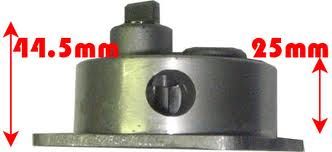
OEM supplier manufacturers' pump housings will have an "A" or "B" in the casting number, but third-world clones may not. Here 's a 111 115 107AK (21mm gears, large passage, 3-rivet "flat" cam, stock in 1970 and early `71 and used as a replacement when a 3-rivet cam is installed in a later engine:
This is the BK (26mm gears):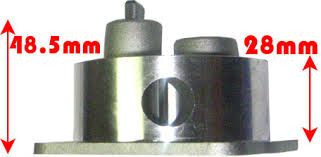
There are also "heavy duty" versions with a thicker flange to allow longer gears, you can buy a 26mm or 30mm version of the AK and a 30mm version of the BK - but a 30mm is seldom required or desired.
Pumps with a 311 number are small-passage, intended for pre`70 cases and 3-rivet cams. You can make one work in a large-passage case by port-matching the inlet & outlet holes to those of the case.
OEM supplier manufacturers' pump housings will have an "A" or "B" in the casting number, but third-world clones may not. Here 's a 111 115 107AK (21mm gears, large passage, 3-rivet "flat" cam, stock in 1970 and early `71 and used as a replacement when a 3-rivet cam is installed in a later engine:
This is the BK (26mm gears):
There are also "heavy duty" versions with a thicker flange to allow longer gears, you can buy a 26mm or 30mm version of the AK and a 30mm version of the BK - but a 30mm is seldom required or desired.
Pumps with a 311 number are small-passage, intended for pre`70 cases and 3-rivet cams. You can make one work in a large-passage case by port-matching the inlet & outlet holes to those of the case.
-
crvc
- Posts: 1564
- Joined: Fri Aug 29, 2003 2:37 pm
Re: Fuel injected type-1 camshaft?
Mine looks like the upper model. The camshaft has three rivets. The pump housing is 25mm. The intake port is 18mm diameter. The outflow port is about 12mm diameter. On the inside there are raised letters; 30 HD SUPER.
I assembled the short block over the weekend. It's the UO case.
I found the leak in the block I'm using now. On the right bottom side there are two 13mm nuts. The leak seems to be coming from one or both of them. But it's a minor leak, barely causing a small drip after 24 hours.
I may try to sell the short block. Or I may keep it as a spare.
kevin
I assembled the short block over the weekend. It's the UO case.
I found the leak in the block I'm using now. On the right bottom side there are two 13mm nuts. The leak seems to be coming from one or both of them. But it's a minor leak, barely causing a small drip after 24 hours.
I may try to sell the short block. Or I may keep it as a spare.
kevin
-
Marc
- Moderator
- Posts: 23741
- Joined: Thu May 23, 2002 12:01 am
Re: Fuel injected type-1 camshaft?
"30HD Super"? Sounds like someone's (like Schadek's) designation for a 30mm-gear (overkill) pump from here. If the housing's only 25mm deep, the flange must be quite a bit thicker than that of the 21mm-gear pump pictured above - I'd guess it's about 12mm thick. It's a large-passage pump so it should be OK on your UO if it's a dual-relief 1970 case. I believe that some time ago we discussed that "UO" is not definitive on a Type III case since the same codeletter was also used on `68/`69 single-relief cases. A large-passage pump will function on a small-passage case, but the ports don't line up very well (and you aren't going to open the passages up in the case to match them on an assembled engine).
The 13mm nuts along the case seam shouldn't be wet unless there's leakage between the case halves making it to their studs. One could possibly seal the leakage off by removing the nuts, cleaning the surface and smupping sealant all over their washers before reinstalling. The two that are higher up, straddling the front cam bearing, receive this treatment upon assembly at the factory (rebuild gasket sets contain paper rings that are to be coated with sealant and installed under the washers) - and many use 111 115 161 "seal nuts" here when rebuilding instead of washers...those could be effective at the bottom location too I suppose, but at ~$1.75 apiece I'd try the sealant first.
If the leak is at the parting line itself you could try cleaning it and using some epoxy putty (JB Weld and others make it, ~$6). The key to success is a clean and roughened surface that the putty can adhere to, so drain the engine and flip it over first. When it's time to split the case, it may take a a few taps with a chisel to cut the patch apart.
The 13mm nuts along the case seam shouldn't be wet unless there's leakage between the case halves making it to their studs. One could possibly seal the leakage off by removing the nuts, cleaning the surface and smupping sealant all over their washers before reinstalling. The two that are higher up, straddling the front cam bearing, receive this treatment upon assembly at the factory (rebuild gasket sets contain paper rings that are to be coated with sealant and installed under the washers) - and many use 111 115 161 "seal nuts" here when rebuilding instead of washers...those could be effective at the bottom location too I suppose, but at ~$1.75 apiece I'd try the sealant first.
If the leak is at the parting line itself you could try cleaning it and using some epoxy putty (JB Weld and others make it, ~$6). The key to success is a clean and roughened surface that the putty can adhere to, so drain the engine and flip it over first. When it's time to split the case, it may take a a few taps with a chisel to cut the patch apart.